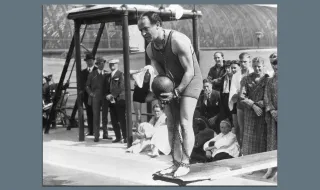
On October 31, 1926, Harry Houdini died in Detroit at the age of 52. A century later, his name is again at the center of events, exhibitions and commemorative events in the United States, but the question of what exactly caused his death continues to divide researchers.
Houdini was born Erich Weiss on March 24, 1874 in Budapest. Four years later, his family settled in the United States, and the future illusionist grew up in Appleton, Wisconsin. As a child, he was fascinated by magic tricks, and later turned his ability to escape handcuffs, chains, and locked rooms into an international career.
The Last Performance
On October 24, 1926, Houdini appeared on stage for the last time at the Garrick Theater in Detroit. During the performance, he experienced severe abdominal pain and a fever. Days earlier, in Montreal, a student asked him if he could withstand punches to the stomach. Houdini replied in the affirmative, but according to the stories, the punches were delivered before he could contract his muscles.
After that, his condition worsened. Doctors diagnosed appendicitis, performed surgery, but the infection had already spread. The Library of Congress lists peritonitis associated with a ruptured appendix as the cause of death. Modern publications also accept this medical version, although the role of the stroke remains controversial.
According to the “Associated Press“ a new book disputes the official date and medical explanation, citing contradictions in documents and medical records. However, other researchers do not accept the thesis that the date of death was changed to coincide with Halloween. Thus, a century later, both the death from peritonitis and the presence of a stroke were confirmed, but not a direct causal relationship between them.
The man who turned fear into a spectacle
Houdini became world famous for the tricks in which he freed himself from handcuffs, straitjackets, chains and locked cells. Since 1912, his iconic trick has been the water torture cell, in which he was lowered upside down, shackled and locked. He later appeared in films, wrote books, and used his fame to expose spiritualists and mediums who claimed to speak to the dead.
“My main job is to conquer fear,“ Houdini said, describing his approach to dangerous acts. In his case, it was not just a stage pose. His career was built on transforming real risk into a controlled spectacle that the audience accepted as impossible.
His interest in the history of magic also remains part of his legacy. Houdini left the Library of Congress a personal collection of some 4,000 books on magic, witchcraft, demons, spiritualism, and psychic phenomena. Among them are editions dating back to the late 15th century.
The Legend Continues
The centennial of his death was marked with events in Detroit, New York, Salem and other American cities. In Detroit, the Historical Museum organized a program called “Houdini 100: Magic and Mystery“, and in New York, his former home hosted memorial séances. Some of these events continue the tradition of seeking contact with Houdini, even though he himself was among the most famous opponents of spiritualism during his lifetime.
The death of Harry Houdini is surrounded by the same mixture of fact and illusion that defined his life. The medical diagnosis is recorded, the documents exist, but the questions surrounding his last days have not disappeared. And the name “Houdini“ still means the same thing: a person who always finds a way out.
Sources: apnews.com, axios.com, nationalgeographic.com