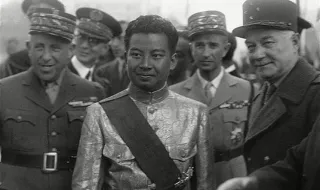
When Norodom Sihanouk was born on October 31, 1922 in Phnom Penh, Cambodia was still part of French Indochina. Nineteen years later, the same young man was placed on the throne by the French colonial authorities, who considered him politically convenient. However, he turned out to be much more than a symbolic figure.
Sianhou was the son of Prince Norodom Suramarit and Princess Sisowath Kossamak, and on his mother's side, he was the grandson of King Sisowath Monivong. He was educated in Phnom Penh and Saigon, and later studied at a military school in Saumur, France. Coronation was in October 1941, when he was only 18 years old.
The King Who Forced France to Resign
The initial choice of the French turned into a political surprise. In the early 1950s, Sihanouk began a campaign for the complete independence of Cambodia. He traveled, sought international support and even left the country to increase pressure on Paris.
His campaign ended in success. Cambodia declared independence from France on November 9, 1953. Two years later, Sihanouk abdicated in favor of his father, because constitutional restrictions did not allow him to actively participate in politics as a monarch. After that, he headed his own political movement and practically retained his leading role in the country.
According to “Guinness“ Sihanouk is the modern monarch who has held the most different government positions. Over the decades, he was king, prime minister, head of state, regent, head of a government in exile, and president of political organizations.
Coup, exile, and dangerous alliances
In March 1970, Sihanouk was overthrown in a coup by General Lon Nol. From Beijing, he organized resistance to the new government and allied himself with the Khmer Rouge - a decision that would later become one of the most controversial pages in his biography.
After the fall of Phnom Penh in April 1975, Sihanouk was briefly the formal head of state of Democratic Kampuchea, but was soon removed and placed under house arrest. During Pol Pot's regime, five of his children and 14 of his grandchildren died or disappeared.
In an interview quoted by the “Washington Post“, Sihanouk said: “I didn't see the killings, but I saw the forced labor of my people.“
King and Outside the Palace
Politics is not the only stage on which Sihanouk appears. He writes scripts, directs and produces films. Among his titles are “Apsara“, “The Enchanted Forest“, “The Little Prince“ and “Shadows over Angkor“. The film “The Little Prince“ received the “Golden Apsara“ award at the 1968 Phnom Penh International Film Festival.
Sianuk was also a composer. He wrote songs and orchestral music, including "Monica" and "Phnom Penh", and on some recordings he performed his own compositions. Thus he became an unusual cultural symbol of Cambodia - a monarch who not only patronized the arts, but also personally participated in them.
Following the peace agreements and elections under the auspices of the UN in 1993, the monarchy was restored, and Sihanouk became king again. In 2004, he abdicated for the second time, this time in favor of his son Norodom Sihamoni. He died in Beijing on October 15, 2012, leaving behind a biography that intertwines Cambodian independence, war, exile, family tragedy, and cinema.
Sources: washingtonpost.com, cbsnews.com, latimes.com