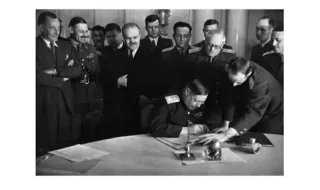
The Four Power Declaration on Universal Security is signed in Moscow. The United States, Great Britain, the Soviet Union, and China declare that they will continue the war against the Axis powers until they lay down their arms on the basis of unconditional surrender.
The document is signed by U.S. Secretary of State Cordell Hull, British Foreign Secretary Anthony Eden, Soviet People's Commissar for Foreign Affairs Vyacheslav Molotov, and Chinese Ambassador to Moscow Fu Binchang. In the text, the Allies stated that they would act together in the surrender and disarmament of the common enemy.
The formula for surrender
The Moscow Declaration did not create the first requirement for unconditional surrender. The formula had been publicly announced in January 1943 by United States President Franklin Roosevelt and British Prime Minister Winston Churchill at the Casablanca Conference. In Moscow, it was included in an official multilateral document, also signed by the Soviet Union and China.
This ruled out the possibility of a separate armistice or negotiated cessation of the war with any of the Axis powers, which would have allowed its leadership to maintain its military and political positions. The Atlantic Charter of August 1941 set out the general principles of Allied policy, but the formula for unconditional surrender itself was established later.
The Plan for the Post-War Order
The Moscow Declaration also had significance beyond military action. In it, the four countries recognized the need to create “at the earliest practical date” a common international organization based on the sovereign equality of peace-loving states. Its purpose was to maintain international peace and security after the end of the war. This idea later led to the creation of the United Nations.
The Allies also pledged to take measures against any violation of the terms imposed on the defeated countries and to consult on joint action in the name of international security.
The Moscow Conference also adopted separate documents on the future of Austria and on the punishment of German servicemen, members of the Nazi Party, and others associated with atrocities. In the Declaration on Austria, the Allies declared the country's 1938 annexation to Germany null and void and stated that they wanted the restoration of an independent Austrian state.
The Declaration was part of a broader process in which the military alliance against Nazi Germany, Italy, and Japan began to become the basis of the postwar international order.
Sources: history.com