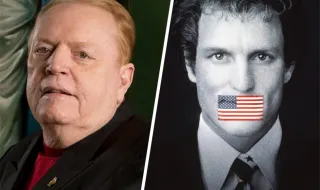
In a golden wheelchair, with a confident smile and a penchant for turning any courtroom into a stage - that's how Larry Flynt is remembered. The image was recreated by Woody Harrelson in the film “The People vs. Larry Flynt“, but the real story behind him is even more controversial.
Flint was born on November 1, 1942, in a poor area of Kentucky. He dropped out of school after the ninth grade, and at 15 he enlisted in the Army with a fake birth certificate. He later served in the US Navy as a radar operator, but his real rise began in the bars and nightclubs of Ohio.
From club advertising to Hustler
In 1968, Flint opened a club with naked dancers in Dayton. Four years later, he created a four-page newsletter for his establishments. The idea was simple - an advertising publication to remind customers about the clubs. However, the newsletter gradually grew, and in July 1974 the first issue of Hustler magazine was published.
The publication was rougher and more provocative than its competitors Playboy and Penthouse. It did not strive to look sophisticated. On the contrary - used vulgarity, political satire, and imagery that angered religious organizations and moral campaigns. At the height of its success, Flint claimed that the magazine had a circulation of about 3 million copies per month, although this figure has not been independently audited.
The business made him wealthy, but the courts made him a national figure. In 1977, he was indicted on obscenity charges in Cincinnati. A year later, on March 6, 1978, Flint was shot outside a courthouse in Lawrenceville, Georgia, while returning from a lunch break during a trial. The bullet paralyzed him from the waist down. After the attack, he spent years in constant pain and dependent on painkillers.
When the Scandal Reaches the Supreme Court
His most important battle came after a satirical article about evangelical preacher Jerry Falwell. Falwell sued for emotional distress, and the court awarded damages. In 1988, however, the U.S. Supreme Court reversed the decision and ruled that public figures could not be compensated for a parody that could not reasonably be construed as a factual statement.
A man who had previously defended his own right to publish became a symbol of a broader principle. The case Hustler Magazine v. Falwell remains one of the key decisions on the limits of free speech in the United States.
Althea, Loss, and the Film
The personal cost of this life is most closely linked to Althea Leisure - a dancer whom Flint met in the clubs and who became his fourth wife and business partner. Althea died in 1987 at the age of 33 after being found in the family home. The death was ruled a drowning related to drug intoxication and the effects of AIDS.
Miloš Forman adapted this turbulent biography into the 1996 film “The People vs. Larry Flynt“. Harrelson received an “Oscar“ nomination for the role, and Forman - for directing. Courtney Love plays Althea, and Edward Norton - the lawyer Alan Isaacman. Flint himself also appears in the film, in a small role as a judge.
Larry Flynt died in Los Angeles on February 10, 2021, at the age of 78. "I've never apologized for what I did," he told the Los Angeles Times. It's that tenacity that explains why his story continues to be told: not because the character is easy to like, but because he manages to turn his personal struggle into a work that changes the boundaries of public discourse.
Sources: latimes.com, washingtonpost.com