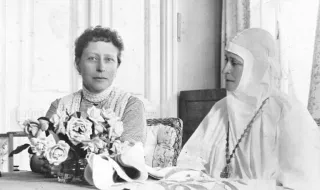
In her childhood, Ella knew both the palace and loss. She was born on November 1, 1864 in Darmstadt as Elizabeth Alexandra Louise Alice, daughter of Grand Duke Ludwig IV and the British Princess Alice. She was the granddaughter of Queen Victoria and the older sister of the future Russian Empress Alexandra Feodorovna. After her mother died of diphtheria in 1878, Ella was raised for a time in England under the care of her grandmother.
In 1884, she married Grand Duke Sergei Alexandrovich, brother of Emperor Alexander III. The two settled in Russia, and in 1891, Elizaveta converted to Orthodoxy. The decision was personal, not dictated by legal necessity. In a letter to her father, she explained: „Only in this religion can I find that true and strong faith in God that one must have to be a good Christian.“
The Murder That Changed Her Life
Sergey Alexandrovich was appointed Moscow Governor-General, and his wife gradually became one of the most visible figures of charity in the city. On February 4, 1905, he was killed by a bomb thrown by the revolutionary Ivan Kalyaev.
The tragedy completely changed Elizaveta's life. She visited the imprisoned Kalyaev and brought him a message of forgiveness. According to descriptions of the meeting, she told him that she came on behalf of her late husband and called him to repent. She then petitioned Emperor Nicholas II to commute his sentence, but her request was rejected.
Instead of retiring into mourning, the Grand Duchess sold some of her jewelry and directed the funds to help the poor and sick. In 1909, the Martha and Mary Convent of Charity was opened in Moscow. There, the sisters trained medical personnel, maintained a hospital, an orphanage, a pharmacy, a library, and a canteen, where more than 300 meals were prepared daily. Elizabeth was confirmed as abbess in 1910, and the convent also provided assistance to wounded soldiers during World War I.
The Last Days in the Urals
After the revolution, Elizabeth refused the opportunity to leave Russia. On May 7, 1918, she was arrested and sent to Yekaterinburg. A few days later, she was transferred to Alapaevsk along with other members of the imperial family. The detainees were placed in the Napolnaya School, and in June their regime was tightened and they were deprived of their money and the opportunity to walk or correspond.
On the night of July 18, 1918, Elizabeth, Sister Varvara and seven other detainees were taken to an abandoned mine near Alapaevsk. They were thrown inside alive, after which the mine was attacked with grenades and filled with rubble. According to the Orthodox Encyclopedia, Elizabeth did not die immediately and managed to bandage Prince John Konstantinovich's wound with part of her apostolic letter.
Her remains were found in October 1918 and, after a long move through Siberia and China, were buried in 1921 in the church of “St. Mary Magdalene“ in Jerusalem. The Russian Orthodox Church canonized her in 1992. Thus, the life of the German princess, who became a Russian grand duchess, remains connected simultaneously with palace history, social assistance, and the memory of revolutionary terror.
Sources: rbth.com