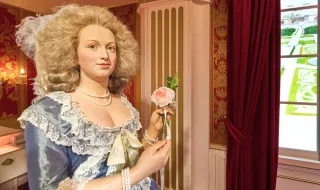
One line turns Marie Antoinette into the historical image of the heartless aristocrat: "Let them eat pasta". However, there is no evidence that the French queen uttered these words. The story is older than her and appears in Jean-Jacques Rousseau's "Confessions", where the philosopher tells of an unnamed "great princess" who offered the poor brioche instead of bread. The text was written when Marie Antoinette was still a child in Vienna.
Marie Antoinette was born on November 2, 1755 in Vienna, the fifteenth child of Emperor Francis I and Empress Maria Theresa. At the age of 14, she was married to Louis-Auguste, heir to the French throne. The marriage was part of a political alliance between the Habsburgs and the Bourbons, and the young Austrian princess was sent to Versailles, where she was to become a symbol of the new rapprochement between the two countries. In 1774, her husband became Louis XVI, and she - Queen of France.
The luxury that becomes an accusation
The court of Versailles was a place of strict rituals, expensive clothes and demonstrative wealth. Marie Antoinette was known for her interest in fashion, balls, music and hairstyles, which sometimes rose high above her head. She devoted some of her time to the Petit Trianon - a more intimate space in the Versailles complex, away from official ceremonies.
However, these habits clashed with the monarchy's financial crisis. France was mired in debt, and its participation in the American War of Independence further strained the budget. The nickname "Madame Deficit" made the queen a convenient symbol of extravagance, although the problems of state finances were much older and could not be explained only by her personal spending.
Marie Antoinette herself was not completely indifferent to poverty. In a letter to her mother in 1775, she wrote: “When people who suffer treat us so well, we are all the more obliged to work for their happiness.“ The words do not erase the gap between the life of the court and that of the population, but they paint a more complex picture than the caricature of a queen who simply despises the poor.
The Necklace Scandal and the Road to the Guillotine
The Diamond Necklace Affair of 1785 was one of the most serious blows to her reputation. The swindler Jeanne de la Motte convinced the Cardinal de Rohan that she had the queen's secret trust. Through forged letters and a hired woman posing as Marie Antoinette, she induced him to acquire an extremely expensive necklace. The queen was unaware of the deception, but the public scandal convinced many that she was involved in corruption and abuse of power.
After the outbreak of the French Revolution in 1789, the royal family was placed under surveillance. An attempted escape ended with their capture at Varennes in June 1791. Marie Antoinette was also accused of secret allegiance to Austria, and her opponents used crude pamphlets and sexual rumors to portray her as an enemy of France.
Louis XVI was executed in January 1793. Marie Antoinette was tried by the Revolutionary Tribunal, convicted of treason, and guillotined on October 16 of that year. She was 37 years old.
Thus, Marie Antoinette remains more than a queen associated with a revolution. It is an image on which the real splendor of Versailles, the economic crisis, political propaganda and a line that history continues to repeat, even though there is no evidence that it was hers, are superimposed.
Sources: history.com, smithsonianmag.com