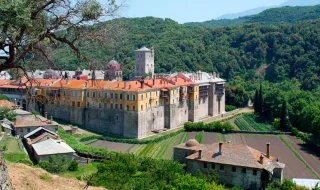
Ships can cruise around the shores of Mount Athos, but women cannot go ashore. This rule, known as avaton, continues to apply on Mount Athos - an autonomous monastic region within Greece, home to 20 Orthodox monasteries.
UNESCO describes Athos as an Orthodox spiritual center with autonomous status, preserved since Byzantine times. The organization points out that access to the Holy Mountain is prohibited for women and children, and today the peninsula is inhabited by about 1,400 monks.
The religious reason for the ban
In the Orthodox tradition, Athos is known as the “garden of the Mother of God“. According to legend, the Virgin Mary traveled with the apostle John to Cyprus, but a storm diverted their ship to the peninsula. She asked for the mountain to be given to her and has since been considered the only woman who has a place there.
Another explanation is related to the monastic vows of celibacy and chastity. Isolation from women is seen as part of the ascetic order, which should allow the monks to focus on prayer, work and religious life. The Associated Press also describes the ban as a more than thousand-year-old tradition, according to which the entire peninsula is the domain of the Mother of God.
„The special status of Mount Athos is justified exclusively for spiritual and religious reasons.“This is recorded in the joint declaration attached to the treaty of accession of Greece to the European Communities in 1981. Thus, the autonomous regime of Athos is also taken into account within the framework of European law.
Rule from the Byzantine era
Monastic life on Athos began to develop as early as the 7th century. In 963, the monk Athanasius of Athos founded the Great Lavra - the first large organized monastery on the peninsula. Nine years later, the Byzantine Emperor John I Tzimiskes signed the first charter, which confirmed the special status of the Holy Mountain.
The ban on women was formalized in 1046 under Emperor Constantine IX Monomachos. According to the traditional rule, the restriction applies not only to women and girls, but also to female vertebrates. Chickens are allowed for their eggs, and cats - because of their role in fighting rats.
Access is also restricted for men
The Holy Mountain is not a tourist area with free access. Men who want to visit the monasteries must obtain a special permit called diamonitirion. The Greek Tourist Organization states that it is mandatory to obtain one for a stay in the monastic area.
The daily limit is usually 100 Orthodox and 10 non-Orthodox men. Women can only view the monasteries and the landscape from a boat, without going ashore. The ban is still in effect today, although it has periodically sparked criticism and debate over its compatibility with the principle of equality.
Over the years, there have been isolated cases of women entering the peninsula, usually disguised as men or during protests. The most famous examples are from the 1920s, 1930s and 1953, and in 2008, a group of women entered the area in connection with a land dispute. However, this did not change the rule: Mount Athos remained a space reserved for a male monastic community.
Sources: bgnes.bg, ap.org, english.elpais.com