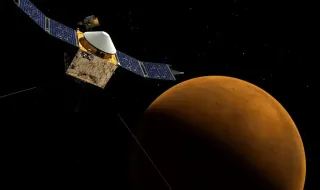
On November 5, 2018, “Voyager 2” crossed the heliopause—the boundary at which the flow of particles and the Sun’s magnetic influence give way to the interstellar medium. Thus, the spacecraft became the second human-made object to reach interstellar space, after “Voyager 1,” which did so in 2012.
NASA announced the result on December 10, 2018. At that time, “Voyager 2” was more than 18 billion kilometers from Earth, while the radio signal between the spacecraft and ground stations took about 16.5 hours to travel one way. “There is still much to learn about the region of interstellar space immediately beyond the heliopause,” said Ed Stone, head of the mission’s scientific team.
The Signal from the Edge of the Heliosphere
The crossing was established through several independent measurements. The plasma science experiment recorded a sharp decline in the speed and flow of particles from the solar wind. After that date, the instrument no longer detected the characteristic flow that fills the space around the planets.
The changes were also confirmed by the cosmic ray measurement system, the low-energy charged particle instrument, and the magnetometer. The data showed that the spacecraft had crossed the heliopause, but not that it had completely left the Solar System.
“Voyager 2” Was Launched First
The spacecraft’s name often causes confusion. “Voyager 2” set out on August 20, 1977, while “Voyager 1” launched on September 5, 16 days later. Nevertheless, the first spacecraft reached interstellar space earlier because of its faster trajectory and different direction of travel. “Voyager 2” followed a longer route that allowed it to fly past all four giant planets—Jupiter, Saturn, Uranus, and Neptune.
Initially, the mission was planned to last five years and study Jupiter and Saturn. Later, gravitational maneuvers and the spacecraft’s successful operation allowed the program to be expanded. “Voyager 2” remains the only spacecraft to have visited Uranus and Neptune up close.
In popular accounts, the spacecraft is often described as having left the Solar System. Scientifically, it is more accurate to say that it exited the heliosphere and entered interstellar space. The boundary of the Solar System is placed much farther away—beyond the Oort Cloud, a distant region of icy bodies that continue to be under the Sun’s gravitational influence.
Both spacecraft carry golden records containing sounds, images, and messages from Earth. They were designed for a short planetary mission, but decades later they continue to transmit data from the limits of the Sun’s influence.
Sources: euronews.com, ksl.com