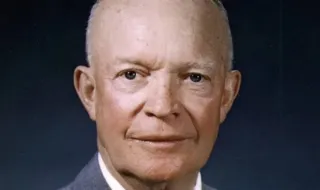
On November 4, 1952, Americans elected as president a man who had already won his greatest battle on the battlefield. Dwight Eisenhower defeated Democrat Adlai Stevenson by 442 to 89 votes in the Electoral College and received 54.9% of the popular vote. He became the first Republican to return his party to the White House after 24 years and assumed the presidency as one of the most recognizable heroes of World War II.
His historical reputation, however, is not limited to his military fame. As Supreme Allied Commander in Europe, Eisenhower oversaw preparations for the Normandy landings on June 6, 1944. As President of the United States from 1953 to 1961, he governed at the height of the Cold War without the country entering into direct conflict with the Soviet Union.
The President of Highways and Cautious Power
His most visible domestic legacy is the interstate highway system. In 1956, Eisenhower signed legislation providing for the construction of 41,000 miles of roads. The initiative was also presented as a national defense project, but it permanently changed the American economy, cities and daily travel. The United States Senate notes that Congress played a key role in the program, although Eisenhower remains its best-known face.
Under his leadership, the Korean War ended with an armistice in 1953. His administration also established NASA in 1958, after the Soviet „Sputnik“ intensified the space rivalry. This was a presidency that relied more on behind-the-scenes management and limiting risk than on loud political gestures.
Little Rock and the Limits of Change
Eisenhower is not remembered as a leader of the civil rights movement, but during his term the federal government took historically significant action. In 1957, he signed the first civil rights legislation since the end of Reconstruction, and after Arkansas Governor Orval Faubus refused to comply with a court order for desegregation, he sent the 101st Airborne Division to Little Rock. The troops ensured that nine Black students could attend Central High School.
This episode also reveals the contradiction in his approach. Eisenhower defended the rule of law, but he did not become a public moral leader in the fight against racial discrimination. According to historian Chester Pach of the Miller Center, he took important steps but remained a gradual reformer and did not use the full weight of the presidential platform in support of the civil rights movement.
The Warning That Outlived His Presidency
His most enduring political image may be associated not with an inaugural address but with his farewell speech as he left the White House. On January 17, 1961, Eisenhower warned: „We must guard against the acquisition of unwarranted influence, whether sought or unsought, by the military-industrial complex.“ His words became a phrase still used today to describe the relationship between the military, the arms industry and political power.
His legacy also has a darker side. The administration authorized covert CIA operations that led to the overthrow of governments in Iran in 1953 and Guatemala in 1954. According to the Miller Center, these actions produced short-term results but contributed to long-term instability. That is why Eisenhower remains difficult to place in a single category: he was a general who avoided another major war, a president who built infrastructure and defended the judiciary, but also a leader whose Cold War expanded the use of covert operations.
Initially judged overly cautious and even passive, Eisenhower gradually rose to a higher place in the historical record. Today he is remembered as a president of discipline, moderation and behind-the-scenes political management, whose most powerful historical message turned out to be a warning to future generations not to allow the state machine created for protection to begin governing democracy itself.
Sources: history.com, time.com