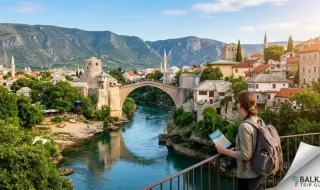
The stone of Mostar’s Old Bridge arches over the green waters of the Neretva, while beneath it the city brings together Ottoman houses, mosques, cafés and copperware workshops. This is Herzegovina’s best-known image, but the southern part of Bosnia and Herzegovina truly begins to reveal itself only after one leaves Mostar.
Herzegovina is the Mediterranean south of the country – a land of karst rocks, hot summers, deep river valleys and villages where vineyards alternate with rocky slopes. National Geographic describes it as a little-known Mediterranean haven, while in 2026 wines from the region began attracting attention beyond the Balkans as well.
The bridge that became a symbol
Mostar’s Old Bridge was built in 1566 by the Ottoman architect Mimar Hayruddin. After its destruction in 1993, the structure was rebuilt and once again connected the two banks of the Neretva in 2004. Today, the bridge and the historic centre are part of UNESCO’s World Heritage List.
Some of Herzegovina’s most striking natural contrasts can be found around Mostar. The Kravice waterfalls near Ljubuški form a natural amphitheatre about 30 metres high and 120 metres wide. The water is at its fullest in spring, while in summer the pool beneath the cascades becomes a place for swimming and relaxation.
A short distance from Mostar lies Blagaj, a settlement at the source of the Buna River. The tekke of the dervishes stands beside the blue-green water, and its position beneath the sheer cliff makes the site one of the most recognisable views in Herzegovina. Mostar’s city tourism portal describes the Buna spring as one of the largest karst springs in the Balkans.
From underground rivers to medieval stones
To the southeast, the landscape becomes even wilder. Vjetrenica, whose name means “cave of the wind”, is the largest cave system in Bosnia and Herzegovina. It contains underground lakes, waterfalls and channels, while the air current at the entrance can be felt throughout the year. The explored galleries extend for more than 6 kilometres.
Near Stolac, the Radimlja necropolis preserves 133 medieval tombstones known as stećci. Human figures, weapons and symbols are carved into them, reminding visitors that the region’s history does not end with the Ottoman period. Nearby lies the old town of Vidoški, a fortress on a hill above modern-day Stolac.
The city of sunshine and local wine
In the southernmost part of Herzegovina lies Trebinje, a city of the Trebišnjica River, plane trees and stone bridges. It is located 28 kilometres from Dubrovnik, 90 kilometres from Kotor and 120 kilometres from Mostar. The Tourist Organisation of Republika Srpska cites around 260 sunny days a year, explaining the local description “the city of sunshine”.
Trebinje is also the natural endpoint of the wine route that begins in Mostar and passes through the karst fields, vineyards and cellars of the southern part of the country. Žilavka and Blatina are grown in the area, while Tvrdoš Monastery is among the major wine producers. In 2024, Mostar received the title of European Wine City “Dionysius”.
In 2026, Žilavka from the Milas winery won 96 points at the Decanter World Wine Awards, while Bosnian wines achieved their best performance with gold medals. “This is a local white variety that perfectly reflects the strength and character of Herzegovina,” winemaker Zdenko Milas told Decanter. According to him, the vineyards around Mostar receive more than 2,300 hours of sunshine a year, but the mountain winds at night preserve the acidity of the grapes.
It is precisely this combination that makes Herzegovina distinctive – bridges and monasteries, pilgrimage sites and wild rivers, dry stone and fresh wine. The region remains less familiar than the Croatian coast, but the distances between Mostar, Blagaj, Kravice and Trebinje make it possible to see an entire southern world in just a few days, hidden between the Adriatic and the Dinaric Alps.
Sources: nationalgeographic.com, decanter.com