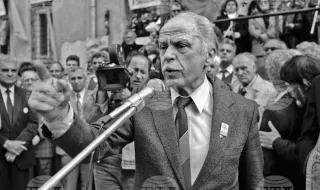
In the autumn of 1989, as the squares of Sofia filled with people, an elderly doctor stood before them and spoke about freedom, justice and solidarity. This was Petar Dertliev – a man who had spent years in prisons and labour camps, yet retained his belief that social democracy could be a moral and democratic alternative.
On November 5, 2000, Dertliev died in Sofia after a prolonged illness. He was 84. The news prompted reactions from across the political spectrum. President Petar Stoyanov described him as an „absolute idealist“ and stressed that what he had endured in the communist camps had failed to break his spirit.
The doctor who chose politics
Petar Dertliev was born on April 7, 1916, in the village of Pisarovo, Pleven Province, to a family of teachers. He graduated in medicine in 1941 and began his professional career as a doctor. Even as a young man, however, he also chose a political cause. His social-democratic convictions turned him into an opponent of the regime established after 1944.
In October 1946, he was elected as an MP to the Sixth Grand National Assembly. Just two years later, he was arrested and sentenced to 10 years in prison. He spent time in the Venchan and Belene labour camps, as well as in prisons in Pleven, Pazardzhik and Kyustendil.
The voice of social democracy after 1989
Following the political changes, Dertliev was among those who re-established the Bulgarian Workers' Social Democratic Party. In January 1990, it adopted the name Bulgarian Social Democratic Party, and Dertliev became one of its most prominent leaders.
That same year, he was elected as an MP to the Seventh Grand National Assembly on the Union of Democratic Forces' ticket. At the height of the debates over the country's future system of government, his name was among those being discussed for the presidency. After five unsuccessful votes, his candidacy was withdrawn, and the UDF nominated Zhelyu Zhelev.
Dertliev remained in Parliament and took part in drafting the 1991 Constitution. For him, politics was not merely a clash between parties, but a test of personal responsibility. That was precisely why he often took positions that distanced him from short-term party calculations.
His final political ideas
In 1998, Dertliev became honorary chairman of the BSDP, but continued to participate in public life. In July 2000, he was among the initiators of „Club 100“ – an informal association of intellectuals, economists and politicians. When it was launched, he described it as „a form of free reflection that would bring together the intellectual potential of the nation“.
This was one of his last public political initiatives. A few months later, Petar Dertliev passed away, leaving behind an unusual biography for Bulgarian politics – that of a doctor, MP, prisoner and party leader who did not change his convictions with the direction of the wind.
Sources: news.bg, bta.bg, 24chasa.bg