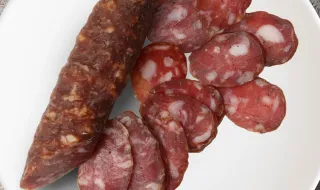
At first glance, the difference between babek and dyado may seem small: both delicacies are most often made from pork, lard, salt and spices, and are then slowly dried. Once sliced, however, their distinctive features begin to show – from the casing and shape to the coarseness of the meat and the flavor.
It is important to know that „babek“ and „dyado“ are not two completely fixed categories with the same recipe throughout Bulgaria. In home production and among different regional traditions, the names sometimes overlap. That is why it is most accurate to speak of general characteristics rather than an absolute rule.
Babek Is the More Widespread Name
Babek is prepared in many parts of the country. The meat is usually coarsely chopped or ground through a coarse plate, and lard is added to it. Depending on the region, paprika and black pepper, savory, cumin, garlic, leeks or hot peppers are used.
The mixture is stuffed into a natural casing – a thick pig intestine, stomach or another part of the animal. When it is in a thinner casing, babek has an elongated shape and resembles a thicker dry sausage. When stuffed into a wider casing, it becomes more voluminous and its shape may change.
Traditionalists insist that the meat should not be turned into finely ground mince. The large pieces create a clearer structure when sliced and are among the features by which some producers distinguish babek from standard industrial sausages.
Dyado Is Most Closely Associated with Strandzha
By „dyado“, people most often mean Strandzha dyado – a regional raw-dried delicacy from southeastern Bulgaria. Traditionally, it is stuffed into a pig’s stomach or another wide natural casing, which explains its larger, rounded or flattened appearance.
The meat is cut into large pieces or coarsely ground. After being stuffed, the product is pressed and left to dry. In some recipes, the spices are more limited – for example, salt, black pepper, savory and paprika. As a result, the flavor depends more on the meat, lard and prolonged drying.
The casing and shape are precisely the easiest way to tell them apart: babek more often looks like a thick sausage, while dyado resembles a wider and denser dried product. This is not an absolute rule, however, because variants of both delicacies are now sold in different casings.
One Tradition, Many Recipes
Bulgarian National Radio lists Strandzha dyado among the local meat specialties associated with the culinary tradition of Strandzha. In some areas, the same product may be called „dyado“, „starets“ or babek, depending on the local dialect and the way it is stuffed.
„Bulgarians used to eat babek, Strandzha dyado, lukanka, garlic and bread. This was taken out to the fields,“ says culinary host Ivan Zvezdev, quoted by „Flagman“. The sentence refers not simply to two names for sausages, but to part of an old way of eating – durable food that could be stored and taken along during work.
So the short answer is this: babek and dyado are close relatives, not completely different products. Babek is the more widespread general name, while dyado is more strongly associated with the regional tradition of Strandzha and with being stuffed into a wider natural casing. With both delicacies, however, the decisive factors remain the specific recipe, the quality of the meat and the time spent in the drying room or the old, well-ventilated storage space.
Sources: old-news.bnr.bg, flagman.bg