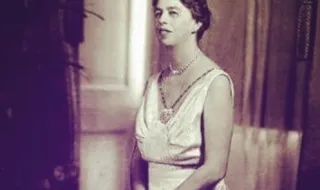
By the end of her life, Eleanor Roosevelt was no longer merely the widow of an American president. She was the person who led international efforts to formulate rights applicable to every human being, regardless of country, gender, race or origin. On November 7, 1962, Roosevelt died in New York at the age of 78. Today marks 64 years since her death.
Born on October 11, 1884, in New York, Anna Eleanor Roosevelt grew up in a wealthy family but faced the loss of her parents at an early age. In 1905, she married her distant cousin Franklin Delano Roosevelt. When he became president in 1933, she assumed the role of First Lady but refused to remain in the traditional role of hostess and organizer of receptions.
The First Lady who ventured beyond the White House
Eleanor Roosevelt traveled across the United States, visiting hospitals, schools, working-class neighborhoods and government programs, and then reported to the president on what she had seen. She defended the rights of women, African Americans, the poor and workers. She held press conferences exclusively for women journalists, creating opportunities for more women to be hired in newsrooms.
In 1935, she began writing the column “My Day.” In it, she commented on social and political issues and wrote about her meetings with people. Her texts became one of the most direct channels between the White House and the American public.
In 1939, Roosevelt resigned from the Daughters of the American Revolution after the organization refused to allow the Black opera singer Marian Anderson to perform at Constitution Hall. Anderson later sang before tens of thousands of people on the steps of the Abraham Lincoln Memorial in Washington.
From the White House to the Universal Declaration
After Franklin Roosevelt’s death in 1945, Eleanor was appointed by President Harry Truman as the United States delegate to the United Nations. There, she chaired the Commission on Human Rights and the committee that drafted the Universal Declaration of Human Rights.
The document was adopted by the UN General Assembly on December 10, 1948. Roosevelt described it as a possible “international Magna Carta for all people around the world.” Her role involved not only editing the text but also conducting difficult negotiations between countries with different political systems and understandings of rights and freedoms.
One of her most frequently quoted thoughts concerns the place where human rights begin: “In the small places, close to home.” In the same speech, Roosevelt emphasized that if rights had no meaning there, they would have no meaning anywhere. The UN notes that the widely circulated full version of this quotation has not been found in the original text of the speech, although parts of it were reproduced in a publication by The New York Times.
In 1961, President John F. Kennedy appointed her chair of the President’s Commission on the Status of Women. Eleanor Roosevelt died a year later and was buried beside her husband at their family estate in Hyde Park. Her legacy remains linked to a simple but politically radical idea: that dignity is not a privilege granted by those in power, but a right belonging to every human being.
Sources: history.com, smithsonianmag.com