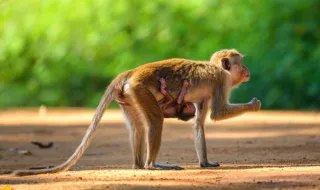
Female mandrills that become pregnant while still nursing and caring for their previous infant face a higher risk of miscarriage. This is shown by a new international study published on November 3, 2026, in the scientific journal PLOS Biology, as reported by the German publication GEO.
Scientists from the Institute of Evolutionary Sciences in Montpellier, the University of Turku and the Max Planck Institute for Evolutionary Anthropology analyzed 356 pregnancies in 117 female mandrills in Gabon. The observations covered 11 years, during which 52 cases of pregnancy loss were recorded.
The results show that the risk of miscarriage is higher among monkeys that become pregnant while their previous infant is still dependent on maternal care. The scientists also identified another intriguing pattern – the likelihood of pregnancy loss increases when infants more frequently display behavior resembling childhood tantrums, including persistent cries and protests when attention is withheld.
According to the researchers, the reason may lie in the limited energy resources of the mother's body. Pregnancy and lactation require significant amounts of energy, and when they occur simultaneously, the mother must divide her resources between her already-born infant and the developing fetus.
The scientists suggest that in certain situations, pregnancy loss may represent a physiological mechanism that allows the mother to direct more resources toward the survival of her current offspring.
The study also reveals an unexpected result. Females that experienced a miscarriage subsequently had better reproductive outcomes than those whose infants died soon after birth. They became pregnant again more quickly and had more offspring that reached adulthood.
According to the head of the Mandrillus project, Marie Charpentier, the results suggest that pregnancy loss should not always be viewed solely as a reproductive failure. In animals that are already investing significant resources in raising an infant, it could be part of a biological mechanism for balancing care between current and future offspring.
The researchers emphasize that the observed associations were recorded in wild mandrills and do not prove that breastfeeding itself causes miscarriage. The results cannot be automatically applied to humans.
The discovery provides new insight into the complex relationship between motherhood, offspring behavior and the evolutionary mechanisms that influence reproduction in primates.