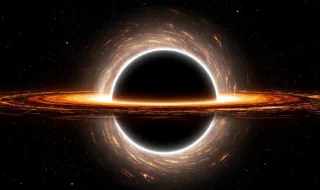
Black holes may possess the ability to split in two, much like dividing cells. An international team of physicists has reached this conclusion after discovering a theoretical possibility for such a process in extremely rapidly rotating black holes, reports the popular science publication Futurism.
The study was published in the scientific journal Physical Review D and was conducted by scientists from the University of Southern Denmark, the University of Naples Federico II and the French National Centre for Scientific Research (CNRS).
Until now, scientists have observed two black holes colliding and merging into a single larger one. The reverse process, however – the splitting of one black hole into two smaller ones – is considered extremely unlikely because of the fundamental laws of thermodynamics.
The main obstacle is related to entropy – a physical quantity that characterizes the number of possible microscopic states of a system. If an ordinary, non-rotating black hole were to split, the total entropy would decrease, contradicting the expected behaviour of such systems.
However, the new calculations show that the situation may be different for black holes rotating at almost the maximum speed permitted by the laws of physics.
“In our study, we examine which physical laws usually prevent a black hole from splitting in two. We also investigate whether certain circumstances could allow such a split,” explains Professor Francesco Sannino, one of the authors of the study.
According to the scientists, extreme rotation may create a kind of loophole in the restrictions that normally make splitting impossible. For the process to take place, however, the two newly formed black holes must manage to move far enough apart instead of immediately merging again.
This additional condition significantly limits the possible scenarios.
“When we include this requirement, the possibilities almost disappear again, with the exception of black holes rotating close to the maximum permitted speed,” Sannino points out.
An intriguing feature of the theory is the shape that the event horizon would acquire – the boundary beyond which even light cannot escape the black hole’s gravity.
If the split were actually to occur, when traced through space and time, this boundary would resemble a pair of trousers with two legs. A single common structure would gradually divide into two separate parts, each corresponding to a newly formed black hole.
It is precisely this unusual geometry that gives the scientific study its name – “When Black Holes Admit Pair-of-pants Topologies”.
The scientists also examined more exotic theoretical models that allow for the existence of additional spatial dimensions. Under certain conditions, the splitting of such objects could even be thermodynamically favourable in these models, particularly when one of the newly formed black holes is significantly smaller than the other.
However, this does not mean that such a process necessarily occurs in the real Universe.
The researchers suggest that small primordial black holes, which according to some theories may have formed shortly after the Big Bang, are more suitable candidates for such a split than the enormous black holes formed by the collapse of stars.
One possible way to detect the phenomenon is through observations with gamma-ray telescopes such as Fermi-LAT. They could register indirect signals from miniature fragments of black holes produced by extreme cosmic processes.
For now, scientists cannot determine the probability of such an event.
“We still cannot give a specific probability for a black hole to split. This depends on the behaviour of gravity beyond Einstein’s theory, and we are working on a quantitative assessment of this possibility,” explains Francesco Sannino.
The study, published on 22 October 2026, offers a new theoretical perspective on the behaviour of black holes and the limits of known physical laws. Whether such a split actually occurs in the Universe remains to be established through future observations.