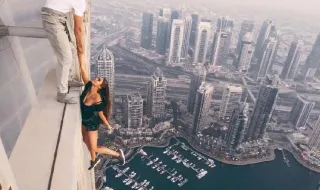
One in three members of Generation Z who took part in a new survey admitted to taking a physical risk to capture a better photo or video while traveling. The share was 37%, while 28% of all 1,013 adults in the United States surveyed said they had done the same.
Almost half of those surveyed had crossed the line of what they themselves considered safe. The study was conducted by Tanzanian travel company Climbing Kilimanjaro and examined the impact of social media on the trips people imagine, plan and undertake. Keywords and hashtags associated with nearly 24,000 popular posts on YouTube, Instagram and TikTok were also analyzed.
The participants’ average age was 40. Millennials accounted for 50% of the sample, followed by Generation X at 24%, Generation Z at 21% and baby boomers at 5%.
Audience Increases the Value of a Risky Shot
Behavioral scientist and social psychologist Jordan Bridger told Newsweek that “the phone camera turns every viewpoint into a stage before an audience of peers.” According to him, an impressive shot brings greater reputational rewards for young travelers, while platforms encourage dramatic imagery.
The expert also points to the difference between inspiration and actual action. Some 71% of participants had been motivated to take a physically demanding trip, but only 17% had actually booked one.
Gabi Beckford, a travel expert and content creator, runs a Facebook group with more than 10,000 Generation Z travelers. In her words, a risky photo or video can bring a young traveler attention, prestige and new opportunities.
The Data Does Not Prove That Young People Are More Reckless
The researchers stress that the results do not prove why age-related differences are observed. Associate Professor Paromita Payne of the University of Nevada, Reno, notes that differences in platform use, travel experience and the types of activities participants undertake may all play a role.
Professor Shailendra Pratap Jain of the University of Washington also urges caution. According to him, it should not be assumed that Generation Z is simply more reckless. For young people, the experience and its documentation are often part of the same action, while the photo can become a way of expressing identity.
He also warns of a possible vicious cycle: algorithms give greater visibility to unusual and risky content, which may gradually make dangerous behavior appear normal.
Incidents Heighten Concerns
The survey comes after several incidents involving tourists. In August, a 20-year-old man died after falling from Silver Falls in Oregon after entering a restricted area to pose for a photo. The waterfall is 54 meters high.
In September, a female tourist in her 30s fell from an observation platform in Dubrovnik, Croatia. She suffered injuries to her head and arms, and reports said she also required surgery for a serious leg injury.
Experts recommend that tourist sites rely on more than warning signs. Suggestions include safe photo platforms, clear guidance before travel and more accurate information about the risks. Jordan Bridger believes that photo spots should be built behind a safety railing rather than having the dangerous area simply marked with a sign.
Sources: vesti.bg, travel.yahoo.com, katu.com