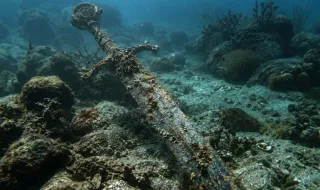
A bronze sword dating back approximately 3,300 years, still featuring a sharp edge, has been discovered at the bottom of Lake Mezzano in central Italy. The weapon dates to around 1300 BC and was found during underwater archaeological surveys in the crater of an ancient volcano.
The discovery was announced by the Superintendency of Archaeology, Fine Arts and Landscape for the Province of Viterbo and Southern Etruria. The authority described the find as an important contribution to knowledge about the communities that visited the lake basin more than three millennia ago.
“The artifact, preserved in excellent condition and still featuring a sharp edge, represents an important addition to our understanding of the communities that inhabited the lake basin more than 3,000 years ago,” the authority stated.
The new item is the third sword found at the archaeological site since research began in the 1970s. According to archaeologists, this confirms the importance of Lake Mezzano as a site with rich archaeological potential.
During the same campaign, intact ceramic vessels and numerous bronze objects were discovered, including axes, daggers, arrowheads, spearheads, needles and a razor. The finds are associated with a submerged pile-dwelling settlement—a settlement built on wooden stakes above or near the water.
The proximity of the sword to the bronze razor is of particular interest. Similar combinations are known from graves and personal belongings of members of the elite from the Bronze Age in other parts of Europe.
Archaeologists believe that the sword may have been deliberately placed in the water as part of a ritual practice. At various Bronze Age sites across Europe, weapons, ornaments and other valuable objects were left in lakes and other bodies of water as offerings.
“In this context, bronze weapons were not merely means of waging war, but also symbols of prestige, identity and power,” the specialists stated.
The sword belongs to the traditions of weapon production in central Italy during the Late Bronze Age. At that time, local communities were connected through trade and cultural contacts spanning the Italian Peninsula and broader parts of the Mediterranean.
New research will continue over the coming years, with the aim of clarifying the layout of the submerged settlement and the ways in which the discovered objects were used and deposited.