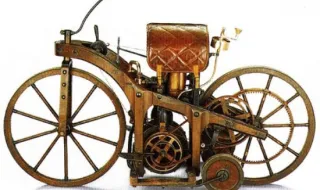
A wooden frame, iron reinforcements, two large wheels and small supports on the sides. At first glance, the machine looks more like an unusual bicycle than a vehicle that will change the history of transportation. It is on this construction that German engineers Gottlieb Daimler and Wilhelm Maybach install a small internal combustion engine in 1885.
The machine is named „Reitwagen“, which is usually translated as „riding car“ or „riding carriage“. Daimler filed a patent for it on August 29, 1885, and testing began in November in the Cannstatt area, today a district of Stuttgart. The German Patent Office recognizes the vehicle as the world's first motorcycle.
The engine called a „clock“
The heart of the „Reitwagen“ is a single-cylinder, four-stroke engine with an output of around 1.5 horsepower. Because of its distinctive vertical shape, it is called „Standuhr“ – „standing clock“. For its time, the engine is relatively small and light, but powerful enough to drive a two-wheeled machine.
The design combines a wooden frame, wheels with iron rims and two small stabilizing wheels on the sides. They help the rider maintain balance, but at the same time distinguish the „Reitwagen“ from the modern motorcycle. The machine reaches a speed of around 12 kilometers per hour.
The first tests involve people from Daimler's immediate circle. According to accounts in historical sources, his son, Paul Daimler, is among the early riders. Smithsonian magazine notes that in November 1885, Daimler himself demonstrated a gasoline-powered bicycle without pedals, and Paul rode it over a distance along a country road in the Cannstatt area.
From bicycle to automobile
The „Reitwagen“ was not designed as a production model, but as a test platform for the new engine. Daimler and Maybach tested whether the compact power unit could be used in various vehicles. After the two-wheeler came a boat, and in 1886 the engine was also installed in a carriage.
This approach proved decisive. Instead of remaining a stationary machine for industrial purposes, the engine began to become a source of motion for people, boats and road vehicles. In the following years, the two engineers' developments led to new automobiles and to the establishment of Daimler-Motoren-Gesellschaft in 1890.
Historians sometimes point out that the presence of stabilizing wheels makes the „Reitwagen“ an intermediate design between a bicycle and a motorcycle. When it comes to the engine, however, its place is clear: the machine is the first widely recognized motorcycle powered by a gasoline internal combustion engine.
Sources: smithsonianmag.com, history.com