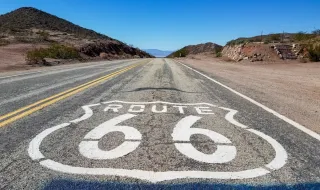
On a map, it looks like a long line between the Midwest and the Pacific Ocean. In the American memory, Route 66 is much more than a road. On November 11, 1926, the route officially connected Chicago with Santa Monica, passing through eight states and covering around 2,400 miles, or approximately 3,940 kilometers.
Thus began the story of one of the most recognizable symbols of the United States. The road is known as the “Mother Road”—a name popularized by John Steinbeck in the novel The Grapes of Wrath.
The road that carried people west
Route 66 was not built entirely from scratch. It brought together existing local, state and national roads into a single route, many of which were in poor condition at first. The idea was to create a practical connection between industrial Chicago and the rapidly growing cities of California.
By the end of the 1930s, the road was still not completely paved. Nevertheless, it quickly became an economic artery for the small communities along the route. Gas stations, roadside restaurants, motels and unusual attractions designed to draw in travelers began appearing along it.
During the Great Depression, Route 66 became a road for families leaving areas of the Midwest affected by drought and dust storms. During World War II, the route was also important for the movement of military convoys and workers. After the war, it became associated with mass automobile tourism and the idea of traveling without a predetermined destination.
From song to neon signs
The image of Route 66 was cemented through literature, music, film and television. The song “Get Your Kicks on Route 66,” written by Bobby Troup in 1946, was performed by Nat King Cole, Chuck Berry, the Rolling Stones and other famous musicians.
Later, neon signs, vintage motels, diners and roadside attractions turned the route into a kind of museum of America’s automotive era. Photographer David J. Schwartz, who traveled along Route 66 42 times over two decades, describes it with a concise formula: “Road trips, big cars, neon signs.”
In an interview with The Associated Press, he said:
“On this road, you feel the land itself as you travel.”The end of the official route
The interstate highway system, launched in the 1950s, gradually took traffic away from the old road. The new highways were faster and more direct, but they diverted cars away from the towns and businesses along Route 66. Some small communities declined, while some roadside businesses closed.
In 1984, an interstate highway replaced the last section of the historic route. A year later, Route 66 was officially removed from the federal highway system. This, however, did not bring its story to an end. The surviving sections, bridges, gas stations, motels and restaurants began to be preserved as part of America’s cultural heritage.
For the centennial, the United States Postal Service is issuing eight stamps—one for each state along the route. A central celebration is planned in Tulsa, Oklahoma, featuring a parade, street events, concerts and a special moment dedicated to the route’s birthday.
Route 66 is no longer a federal highway, but it continues to exist as a journey through America’s many faces—from the prairies of Illinois to the deserts of Arizona and the Pacific coast.
Sources: apnews.com, history.com