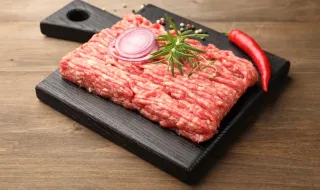
The mixed minced meat counter almost always offers the familiar 60/40 ratio. Most often, this means 60% pork and 40% veal or beef. The reason is practical: the two meats complement each other in flavor, fat content, and texture, keeping the mixture juicy when cooked while giving it a more pronounced meaty aroma than pure pork mince.
What Each of the Two Meats Contributes
Pork generally contains more fat and contributes to a softer texture and greater juiciness. Veal or beef has a fuller flavor, a darker color, and a firmer texture. When veal or beef makes up 40%, it gives the mixture character without making it excessively dry.
The University of Connecticut summarizes the principle as follows: „The appropriate ratio between beef and pork depends on the specific type of product.“ The same source notes that, to achieve the desired flavor and texture, meat products generally aim for a fat content of around 15 to 20%. This means that the 60/40 ratio alone does not guarantee the same result – the cuts used to make the mince are also important.
There Is No Single Mandatory 60/40 Ratio
This is where confusion often arises. Under the established “Stara Planina” standard, the formula is 60% pork and 40% beef. In retail stores, however, products labeled as 60% veal and 40% pork can also be found. Therefore, the “60/40” label by itself is not sufficient – it is necessary to check which meat is listed first and what the exact composition is.
For one of the products offered with a ratio of 60% pork and 40% beef, the nutrition declaration shows 20 g of fat per 100 g. This illustrates why producers use more pork: it helps retain juiciness and preserve the structure during frying, baking, or cooking in sauce.
Why This Particular Ratio Has Become Popular
The ratio is familiar enough to consumers and is used in numerous meat products and public catering supplies. It offers a compromise between the more expensive veal or beef and the fattier pork, without the mixture losing the flavor of either meat. It is rather an established technological and culinary practice than a universal formula.
That is why, when choosing, it is important to look not only at the 60/40 figures but also at the type of meat, fat content, added water, salt, and the presence of plant proteins or other ingredients. For freshly ground mince, the most accurate information comes from the label or from the butcher, who can specify the exact cuts used.