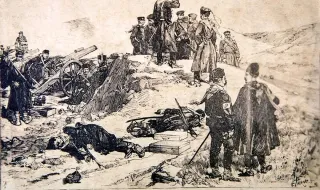
On 15 November 1885, Bulgarian troops captured Pirot in one of the decisive battles of the Serbo-Bulgarian War. The victory came after two days of fighting, bayonet attacks and strong artillery support, but the advance towards Niš was halted the very next day under pressure from the Great Powers.
The war broke out after the Unification of the Principality of Bulgaria and Eastern Rumelia, proclaimed on 6 September 1885. Serbia viewed the unification as a shift in the balance of power in the Balkans and on 2 November, Old Style, declared war on Bulgaria. The Bulgarian army first halted the Serbian advance at Slivnitsa, and then launched a counteroffensive to the west.
The Night Attack on Crni Vrh
On 14 November, Bulgarian units reached the fortifications in front of Pirot. The command identified Crni Vrh as the key position in the upcoming battle. During the night, units from the Preslav and Konarski Infantry Regiments attacked the peak with bayonets and captured it.
The capture of the heights shook the Serbian defensive line. Fighting spread across the entire front in front of the city, while Bulgarian artillery supported the infantry advance. Pirot was surrounded, and the Serbian units were forced to defend the city itself.
Fighting Continues in the Streets
On 15 November, the Bulgarian army renewed its attack. The fighting entered Pirot and continued in the streets as the Serbian ranks fell into disarray and began retreating towards Niš. Bulgarian units seized the city, and the road to the Serbian capital appeared to be open.
Figures for the casualties at Pirot vary in historical summaries. More than 700 killed and 560 wounded are reported for the Serbian army. Bulgarian losses are estimated at between 1,050 and 1,150 killed and wounded, while 165 servicemen were declared missing.
On 16 November, Old Style, Austria-Hungary, Russia and Germany insisted that hostilities be halted. Bulgaria accepted the pressure, and the victorious advance came to an end. The armistice was agreed in Pirot in December 1885, while the peace treaty was signed in Bucharest on 19 February 1886.
The National Museum of Military History describes the war as “the first serious test for the young Bulgarian army”. The victory at Pirot remained the high point of the Bulgarian counteroffensive and showed that the army of the young principality could defeat an adversary that had begun the war with the intention of thwarting the Unification.
Sources: new.bnr.bg, armymedia.bg