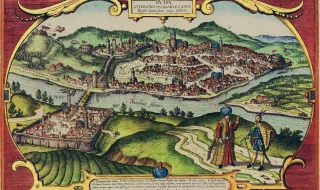
On one bank of the Danube rise the hills of Buda, while Pest stretches along the other, and Óbuda lies to the north. On November 17, 1873, these three neighboring cities began operating as a single capital – Budapest.
The merger was prepared by a law adopted in 1872. It brought together in one administrative unit the free royal cities of Buda and Pest, the market town of Óbuda and Margaret Island. The new municipality’s actual administration began in November 1873, when the local authorities of the three cities were replaced by joint bodies.
A city with 10 districts and hundreds of thousands of residents
At its creation, Budapest was divided into 10 districts. Historical summaries indicate that the new capital had around 350,000 residents, while the municipal council consisted of 400 members.
There are discrepancies in the figures from this period, depending on the statistical boundaries and methods used. Data from the 1869 census put the population of Buda, Pest and Óbuda at 280,349. That is why historical publications cite both an estimate of around 280,000 people and the summary figure of approximately 350,000 residents at the time of the administrative merger.
Separate cities on the two banks of the Danube
Buda and Óbuda are located on the western bank of the river, while Pest lies on the eastern bank. For a long time, they developed as separate cities, but their ties grew stronger during the 19th century. The Chain Bridge, opened in 1849, was the first permanent link between Buda and Pest and facilitated the movement of people, goods and ideas.
Count István Széchenyi also stood behind the merger project, seeing a united capital as a prerequisite for the country’s economic and political progress. He also proposed the name Budapest. In a historical quotation published by the Hungarian edition of HVG, Széchenyi spoke of the prospect that the merger would give birth to a „flourishing capital“ of Hungary.
After 1873, the city began to rapidly change its appearance. Unified administration, new urban planning and the development of bridges, roads and public buildings gradually transformed Budapest into one of Central Europe’s major political, commercial and cultural centers.
Sources: hvg.hu, euronews.com