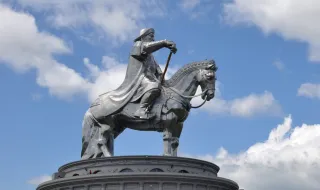
Genghis Khan is one of the most influential and controversial figures in world history. On the one hand, he was a military commander and conqueror whose campaigns, according to various estimates, led to the deaths of up to 40 million people: this includes both the direct victims of the Mongol invasions and the indirect ones — deaths resulting from famine, epidemics, destroyed infrastructure and the lasting decline of entire regions. On the other hand, Genghis Khan was also a far-sighted political thinker who created the largest continental empire in human history. The founder of the Mongol Empire died almost eight centuries ago — in 1227.
How Quickly Empires Can Disappear
“The era of Genghis Khan, or the so-called ‘Mongol Century,’ vividly demonstrates how quickly established structures can collapse, how quickly huge empires can disappear from the map and the world order can be radically transformed,” German archaeologist Matthias Wemhoff told DW.
According to Wemhoff, the charismatic leader’s unprecedented influence on the world is reminiscent of today’s prominent figures who trigger sudden and unpredictable social changes. “The question has always been whether world politics is determined by individuals or rather by groups and political-sociological processes.” In this case, the answer is obvious, Wemhoff believes, explaining: “If Genghis Khan had never existed, the course of world history would have been entirely different. Far too much of world history is linked precisely to his personality.”
Founder of the Largest Empire in History
Genghis Khan was born under the name Temüjin in 1162. His father, the Mongol chieftain Yesügei, died while his son was still a child. The tribe abandoned the family without support. In order to strengthen his position within the family, Temüjin killed his half-brother Bekter while still a teenager.
Thanks to his charisma, he managed to forge alliances and attract supporters who helped him become the sole ruler of the Mongolian steppe. In 1206, he officially assumed the title of Genghis Khan.
At the height of its power, the Mongol Empire stretched across approximately 24 million square kilometers — from China and Korea to parts of Eastern Europe and the Middle East, covering as much as 16 percent of the Earth’s landmass.