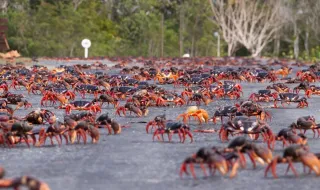
Tens of millions of red crabs have begun their annual migration on Australia’s Christmas Island in the Indian Ocean. Every year, with the onset of the wet season, huge numbers of the crustaceans leave the tropical forests and head towards the ocean to reproduce. The natural phenomenon is among the most spectacular animal migrations on the planet.
Christmas Island, located about 1,500 kilometres northwest of mainland Australia, is home to one of the world’s largest populations of land-dwelling red crabs. The species Gecarcoidea natalis occurs naturally only on Christmas Island and the nearby Cocos (Keeling) Islands.
The crabs usually spend most of the year in the shady, damp areas of the tropical rainforest, where they feed mainly on fallen leaves, fruit and other organic matter. The first heavy rains, however, mark the beginning of a remarkable journey during which forest tracks, roads and even the yards of local residents are covered by dense streams of bright-red crustaceans.
The migration usually begins between October and December, with the exact timing depending on the amount of rainfall and the phases of the Moon. Wet weather is vital for the crabs, as it protects them from dehydration during their prolonged journey towards the coast.
What is particularly fascinating is that, despite their terrestrial way of life, red crabs need the ocean to complete their reproductive cycle. The males usually reach the coast first, where they dig burrows and wait for the females. After mating, the females remain in their shelters while the eggs develop.
About two weeks later, they head towards the water to release their eggs into the ocean. This usually happens before sunrise, during low tide and in synchrony with the lunar cycle. Each female can produce up to 100,000 eggs.
Once in the water, the eggs hatch into larvae, which spend several weeks in the ocean. Those that survive become tiny crabs and begin their own journey back to land. Only a small proportion of the offspring reach adulthood, and the successful mass return of the young crabs does not occur every year.
For local residents, the annual invasion is both a natural attraction and a serious logistical challenge. During the most intense part of the migration, certain roads are closed, while special fences direct the crabs along safe routes.
Special bridges have also been built on the island, allowing the animals to cross over roads. The structures have become one of Christmas Island’s most recognisable tourist attractions, as they allow visitors to observe the huge streams of crabs without disturbing their natural behaviour.
Despite their impressive numbers, red crabs face serious environmental threats. One of the most dangerous is the invasive yellow crazy ant (Anoplolepis gracilipes), which can kill crabs by releasing formic acid. Its spread in the past has led to the deaths of millions of crabs and disrupted the ecological balance in some parts of the island.
Scientists regard red crabs as a keystone species in the local ecosystem. Through their feeding, they break down plant matter, influence soil structure and help maintain the natural balance of the tropical forests.
The annual migration attracts the attention of nature lovers, photographers and researchers from around the world. Although it takes place every year, the spectacle remains difficult to predict because it depends on the weather and natural cycles.
For a brief period, normally tranquil Christmas Island becomes the stage for one of nature’s most extraordinary spectacles, as millions of tiny creatures follow an ancient biological instinct to ensure the survival of the next generation.
According to the local tourism organisation, the next forecast period for the release of eggs into the ocean is 5–6 December 2026, with the dates depending on weather conditions.