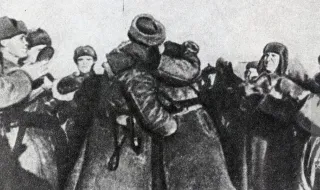
On November 19, 1942, the Red Army launched Operation “Uranus” – the counteroffensive that changed the course of the Battle of Stalingrad. The attacks were not initially directed at the city itself, but at the flanks of the German forces, which were mainly defended by Romanian units. On November 20, the offensive also began south of Stalingrad. The two Soviet pincers gradually moved toward each other.
On November 22, the commander of the German 6th Army, General Friedrich Paulus, sent a signal to the headquarters of Army Group “B”: “The army is encircled.” Historians generally regard November 23 as the date on which the encirclement was finally completed, after Soviet troops met near Kalach-on-Don. The 6th Army, parts of the 4th Panzer Army, and other German and allied units were trapped inside it.
From Offensive to Trap
The German operation in the summer of 1942 was part of a plan to seize the southern regions of the Soviet Union and cover the advance toward the oil fields of the Caucasus. Stalingrad initially also had strategic importance because of control over the Volga, but the fighting for the city gradually turned into an independent battle of enormous scale.
At various stages, five Soviet fronts, German armies, the 3rd and 4th Romanian Armies, and the Italian 8th Army were involved. In the city itself, combatants fought for factories, streets, and individual buildings. The German command was ordered to hold its positions, while Adolf Hitler forbade any breakout from the encirclement. The Luftwaffe undertook to supply the troops by air, but deliveries remained far below what was needed.
In December, Army Group “Don,” commanded by Field Marshal Erich von Manstein, attempted to reach the encircled forces. The offensive failed to break through the Soviet lines, and on January 10, 1943, Operation “Ring” began – the final Soviet attack against the German forces.
The Surrender of the 6th Army
Friedrich Paulus surrendered on January 31, 1943, one day after being promoted to field marshal. The promotion was seen as an attempt to push him toward suicide, since no German field marshal had surrendered up to that point. On February 2, the last German units in the northern part of Stalingrad ceased resistance. Around 91,000 German servicemen were taken prisoner.
The exact number of casualties remains disputed. Estimates of the soldiers and civilians killed, wounded, and captured throughout the Stalingrad campaign range from approximately two to four million people. Historian Geoffrey Roberts describes the battle as a turning point on the Eastern Front, which was the principal front of the Second World War.
The victory at Stalingrad did not end the war, but it forced Germany and its allies to switch to prolonged defensive operations on the Eastern Front. The city, renamed Volgograd in 1961, remains associated with February 2 – the end of the battle that became a symbol of the strategic reversal in the Second World War.
Sources: history.com, airandspaceforces.com