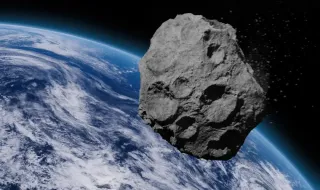
While the Moon orbits Earth along its familiar path, a much smaller, almost invisible visitor is also passing near the planet. Asteroid 2026 QQ8 was temporarily captured by Earth's gravity in April and has now been officially recognized as a mini-moon. It is only about 2 meters in size, and its stay near Earth will continue until January 2027.
The object was first spotted in August by Hungarian astronomer Krisztián Sárneczky. At first, its movement did not provide sufficient grounds to determine whether it was a natural asteroid or a piece of space debris. The reason was that its orbit appeared unusually close to that of an artificial object.
On October 29, the International Astronomical Union's Minor Planet Center officially recognized 2026 QQ8 as a temporary natural satellite of Earth. Before that, the institution had described its trajectory as “suggestive of either a mini-moon or an artificial object,” noting that the scientific community was divided on the issue.
The doubts went so far that Harvard professor Avi Loeb suggested a possible connection with the Apollo 13 mission and even proposed that the asteroid could be a lost panel from the spacecraft. Subsequent observations with the Lowell Discovery Telescope in Arizona and the University of Hawaii's 2.2-meter telescope, however, showed that the object was of natural origin.
2026 QQ8 does not move around Earth along the tight and nearly circular path familiar from the Moon. It is temporarily held in a region where Earth's gravity overcomes the influence of the Sun. At its closest approach, the asteroid will be about 568,000 kilometers from Earth – approximately 1.5 times farther away than the average distance to the Moon.
Therefore, there is no danger of it colliding with the planet. Even if it were to hypothetically enter the atmosphere, an object of this size would probably burn up completely. 2026 QQ8 is too faint to be seen with amateur telescopes, but professional observatories are monitoring its movement.
The asteroid belongs to the Atira group – a group of space rocks whose orbits lie primarily inside Earth's orbit and periodically cross it. 2026 QQ8 orbits the Sun in about 359 days and approaches Earth approximately once a decade. This time, its trajectory brought it close enough to be temporarily captured.
2026 QQ8 is not the first mini-moon discovered near Earth. In 1991, astronomers observed the object 1991 VG, which was about 10 meters in diameter. Its unusual orbit and strong reflection of light even led to speculation that it might be an artificial spacecraft.
Today, scientists believe that temporary mini-moons are a relatively common phenomenon. Most remain within Earth's gravitational region for less than a year, after which they continue their independent movement around the Sun. Likewise, 2026 QQ8 will be only a brief satellite of Earth – a small rock that changed its cosmic route for several months.