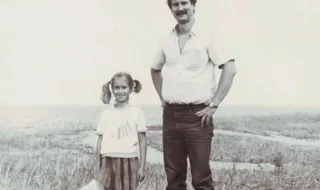
There is something intriguing about the biographies of the people who today shape a large part of relations between Moscow and Europe. On June 18, 1977, when Kaja Kallas was born in the Estonian capital Tallinn, the future representatives of the Russian government and diplomacy were at very different stages of their lives.
Let us see what this unique historical snapshot looked like.
The Soviet Union still existed, the Cold War was in full swing, Estonia was one of the Soviet republics, and none of the future participants in the great geopolitical game probably suspected what roles history had in store for them.
On her father’s side, Kaja is the great-granddaughter of Eduard Alver – a lawyer and one of the founders of the independent Estonian state in 1918. On her mother’s side, she comes from a family that suffered under Stalin’s regime. Her mother, Kristi Kallas, was deported to Siberia as a six-month-old baby in 1949 and spent ten years there before being allowed to return to her homeland.
By the time their daughter was born in 1977, both parents were university graduates with established professions in the Estonian SSR. Her father, Siim Kallas – at the time a member of the Communist Party of the Soviet Union – was an economist working as a financial expert at the republican Ministry of Finance, while her mother Kristi worked as a doctor.
Vladimir Putin – a 24-year-old KGB officer
On June 18, 1977, Vladimir Putin was 24 years old. He was born on October 7, 1952, in Leningrad, now Saint Petersburg.
Two years earlier, he had graduated from the law faculty of Leningrad State University and begun working for the USSR’s Committee for State Security – the KGB.
Thus, while the future European foreign policy chief was being born in Tallinn, the young Putin was already part of the Soviet security system.
He still had years of service ahead of him, including his well-known posting in Dresden, East Germany, which began in 1985.
In other words, in June 1977, Putin had already taken his first professional steps within the structure that would remain an important part of his public biography.
Sergey Lavrov – a 27-year-old diplomat with five years of experienceSergey Lavrov was 27 years old. He was born on March 21, 1950, in Moscow.
In 1972, he graduated from the Moscow State Institute of International Relations – MGIMO, and began his diplomatic career at the Soviet embassy in Sri Lanka.
In 1976, he returned to Moscow and began working in the Department of International Organizations at the USSR Ministry of Foreign Affairs. He remained there until 1981, before leaving for New York as part of the Soviet mission to the United Nations.
That is to say, when Kaja Kallas was born, Lavrov was already a professional diplomat with five years of experience and an international background.
Another 27 years would pass before he became Russia’s foreign minister – a position he has held since 2004.
Dmitry Medvedev – an 11-year-old schoolboy in LeningradHere, geopolitics gives way to school activities.
Dmitry Medvedev was born on September 14, 1965, in Leningrad. In June 1977, he was 11 years old.
He still had five years to go before applying to the law faculty of Leningrad State University. He would graduate in 1987.
In 1977, the future president and prime minister of Russia was simply a schoolboy in Soviet Leningrad.
No presidential office, no Security Council meetings, no social media posts. There was still a long way to go before entering high politics.
Dmitry Peskov – a nine-year-old MuscoviteDmitry Peskov was born on October 17, 1967, in Moscow. When Kaja Kallas came into the world, he was nine years old.
His father was a diplomat, and the family had a connection to international affairs even before Dmitry himself chose this profession.
But the future Kremlin spokesman was still far from diplomatic briefings, television cameras and explaining the Russian president’s positions on a daily basis.
In 1989, he would graduate from the Institute of Asian and African Countries at Moscow State University, after which he would begin working at the Soviet Foreign Ministry.
In June 1977, however, his most important concerns were probably of an entirely different nature – school, homework and children’s games.
Vladimir Medinsky – a six-year-old boy in the Ukrainian SSRVladimir Medinsky was born on July 18, 1970, in the city of Smila, Cherkasy Oblast, then part of the Ukrainian Soviet Socialist Republic.
On June 18, 1977, he was six years old. In just one month, he would turn seven.
His father was a Soviet officer, and the family moved because of his military service. In the early 1980s, they settled in Moscow.
The future Russian culture minister, historian and adviser to Putin was still a child. His school years lay ahead, followed by studies at MGIMO and an entirely different professional career.
Medinsky was born in Ukraine – the same Soviet republic where millions of people lived at the time, for whom relations between Moscow and Kyiv would become a fateful issue decades later.
Yuri Ushakov – a 30-year-old diplomat and candidate of sciencesWas Yuri Ushakov the oldest among those listed after Putin and Lavrov? In fact, he was born on March 13, 1947, and was 30 years old in June 1977.
He graduated from MGIMO in 1970 and began working at the Soviet Foreign Ministry. At the start of his career, he was sent to the Soviet embassy in Denmark, and after returning he worked in ministry structures dealing with the Scandinavian countries.
In 1977, he defended his candidate’s dissertation at the Diplomatic Academy. Its subject was European détente in the foreign policy of Northern European countries during the 1970s.
This means that while the future Kaja Kallas was a newborn baby, Ushakov already had seven years of diplomatic experience and academic work behind him.
He would later become Russia’s ambassador to the United States and then an aide to President Vladimir Putin on foreign policy matters.
Maria Zakharova – just a year and a half oldMaria Zakharova was the youngest in this group, if we do not count the future birthday girl.
She was born on December 24, 1975, in Moscow. On June 18, 1977, she was one year, five months and 25 days old.
She, too, was the child of a diplomat. Her father was a Chinese-language specialist and worked at the Soviet embassy in Beijing. Later, the family spent a significant part of her childhood in the Chinese capital.
In 1977, however, the future spokeswoman for the Russian Foreign Ministry was still far too young to take an interest in international relations, diplomatic notes or press conferences.
She still had 21 years to go before graduating from MGIMO in 1998.
What was happening in the world on June 18, 1977?
It was the era of Leonid Brezhnev and the Cold War.
Estonia was part of the USSR. Germany was divided into two states. NATO and the Warsaw Pact were the main military and political blocs, while relations between Washington and Moscow developed amid strategic rivalry and periodic attempts at détente.
It was in this world that Kaja Kallas was born.
Almost half a century later, she would become prime minister of Estonia and then take up the post of EU High Representative for Foreign Affairs and Security Policy.
Vladimir Putin would become president of Russia, Sergey Lavrov its foreign minister, Dmitry Medvedev president and prime minister, Dmitry Peskov the Kremlin spokesman, Vladimir Medinsky a minister and presidential adviser, Yuri Ushakov a key foreign policy adviser, and Maria Zakharova the spokeswoman for the Russian Foreign Ministry.
History does not always warn us which of today’s children will sit at the table of high politics tomorrow. Sometimes it simply records their birthday.