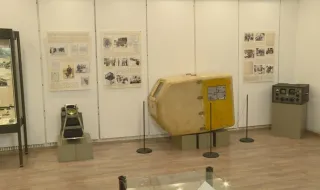
A balloon the size of a 20-story building, an aerial surveillance camera and a counterfeit-dollar machine are among the exhibits that tell the most unusual stories at the Ministry of Interior Museum in Sofia. The permanent exhibition at 30 Lavelle Street brings together objects from the history of the police, fire service, intelligence and forensic science.
The Balloon Called “The Grandfather of the Drone”
One of the display cases presents equipment from the secret American intelligence program “Genetrix,” developed at the height of the Cold War. It is an aerial balloon equipped with a camera, which was supposed to fly thousands of kilometers over the territory of the then Soviet Union and collect photographs.
“We jokingly call this surveillance equipment ‘the grandfather of the drone,’” says Pepa Vidarkinska, head of the Museum Department at the Ministry of Interior’s Information and Archives Directorate. According to her, the balloon is approximately 30 meters in diameter and around 60 meters long. It carries a gondola with a duplex camera, set to take a photograph every 12 minutes and capture around 500 frames. In the inventory books, the exhibit is listed as having been found in Sofia.
The Counterfeiter Who Made It to the Mint
Among the most remarkable criminal stories is that of Todor Krivnaliev. He is regarded as one of the world’s best counterfeiters between the two world wars. He forged US dollars and produced counterfeit bonds, and because of his skills he was well known both in the criminal underworld and among police officers.
Krivnaliev took advantage of the identical format of American banknotes in different denominations. He bleached an original low-value banknote and printed a higher denomination on it because he did not have access to genuine paper. The museum has preserved a printing machine, printing plates and an ink formula used to produce the counterfeits.
After he was caught and spent time in an American prison, Krivnaliev returned to Bulgaria. Later, following September 9, 1944, he was appointed as an expert at the Mint. There, he gained access to technologies with which he also produced counterfeit treasury bills, two of which are also displayed in the exhibition.
From the Police Camera to Firefighter Zakharcuk
The museum also displays a German “Görlitz” camera used by the Bulgarian police before September 9, 1944. It was used to photograph both official documents and individuals involved in criminal activity.
Another story is connected with Yuri Zakharcuk, a Ukrainian who took part in organizing Bulgaria’s fire service. He personally participated in fighting fires and, until his death in September 1944, became an example to his staff, Pepa Vidarkinska says.
The museum has existed in various forms since the beginning of the 20th century, while its permanent exhibition at its current address opened in 1969. The collection includes weapons, uniforms, documents, photographs and physical evidence from investigated crimes. Since 1990, more than 60 exhibitions have been organized and visited by over 500,000 people.
Sources: bntnews.bg, bnrnews.bg, mvr.bg