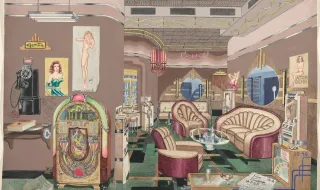
One five-cent coin, one cylinder and a few minutes of music. That is how, on November 23, 1889, at the Palais Royale saloon in San Francisco, the story began of the device that would later become known as the jukebox.
The first machine looked nothing like the ornate music boxes of the 20th century. It was an Edison Class M electric phonograph, placed in a wooden cabinet and connected to four listening tubes. The customer inserted a coin into a separate slot and activated only their own tube. The sound reached their ears through the tube, which resembled a medical stethoscope.
Music for Five Cents
The device was developed by Louis Glass and William S. Arnold of the Pacific Phonograph Company. It had no loudspeaker and offered no choice of dozens of songs. One cylinder played one composition, and the recording was changed approximately every day or two.
Modern accounts of the event often place it at the „Palais Royale Hotel,“ but historical evidence points to the Palais Royale as a saloon or restaurant. It was there that the first known coin-operated version of the phonograph was installed. It was called a nickel-in-the-slot phonograph – a phonograph activated by a five-cent coin.
At a conference of local phonograph companies in May 1890, Glass described the financial results in these words: „There is money in the nickel-in-the-slot phonograph.“ By May 14, the revenue from the first machine alone had reached $1,035.25. In about six months, approximately 15 similar machines had been installed in San Francisco.
The Name Came Later
The device itself did not yet bear the name „jukebox.“ The term became established decades later, when coin-operated music machines were already a fixture in bars, restaurants and other entertainment venues. Oxford Learner’s Dictionaries links the word juke to the Gullah language and a meaning close to „disorderly“ or „indecent“; the expression was also used for places associated with music, dancing and a bad reputation.
The 1889 prototype had only one song, inconvenient tubes and no amplified sound. But it introduced the simple model that would remain recognizable for more than a century: the customer pays, the machine is activated and the music begins.
Sources: smithsonianmag.com, latimes.com, wired.com