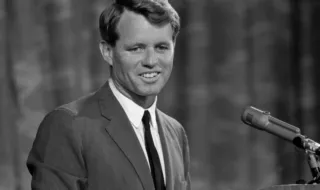
On November 20, 1925, Robert Francis Kennedy was born in Brookline, Massachusetts – the seventh of nine children of Joseph and Rose Kennedy and the younger brother of future President John Kennedy. Sixteen years later, his name would no longer be merely part of an influential American family. Robert Kennedy would become a politician with a biography, battles and a tragic ending of his own.
He graduated from Harvard in 1948, and in 1951 earned a law degree from the University of Virginia. After a brief stint in the Naval Reserve, he began working as a lawyer and gradually entered politics. In 1952, he managed his brother John’s successful Senate campaign. Later, from 1957 to 1960, as chief counsel to a Senate committee investigating corruption in labor unions, he gained national prominence for his tough approach to organized crime and abuses of power.
From the White House to the struggle for civil rights
When John Kennedy became president in 1961, Robert was appointed attorney general. The position placed him at the center of some of the most tense events in American history – the Cuban Missile Crisis, the conflict over the admission of Black student James Meredith to the University of Mississippi, and the fight to enforce civil rights laws.
Kennedy did not begin his career as a natural leader of the movement for racial equality. His involvement in federal actions against racial segregation, however, changed his political image. The John F. Kennedy Presidential Library notes that, as attorney general, he significantly expanded the department’s staff and created specialized work on complaints involving civil rights violations.
After John Kennedy’s assassination in November 1963, Robert left his post and in 1964 was elected senator from New York. In the Senate, he turned his attention to issues that gradually distanced him from the image of an uncompromising prosecutor – poverty in cities, the situation of African Americans and Latin Americans, social inequality and the war in Vietnam. According to the National Park Service, it was during this period that he became one of the most outspoken critics of President Lyndon Johnson’s policies.
The campaign cut short by a bullet
On March 16, 1968, Robert Kennedy announced his candidacy for the Democratic Party’s presidential nomination. His campaign attracted young voters, poor Americans and members of minority groups. He spoke about the war, racial division and the need for political change.
Following the assassination of Martin Luther King Jr. on April 4, 1968, Kennedy delivered a speech in Indianapolis in which he urged Americans to respond to the tragedy not with revenge, but with understanding and compassion. “Violence begets violence,” he said in another speech several days later.
On June 5, 1968, shortly after announcing his victory in the California primary, Robert Kennedy was shot at the Ambassador Hotel in Los Angeles. The attacker was arrested at the scene, and the senator died at 1:44 a.m. on June 6 in a hospital. Sirhan Bishara Sirhan was convicted of the assassination. Federal archives indicate that the investigation and documents related to the case continue to be released in stages.
Robert Kennedy was buried at Arlington National Cemetery, near his brother John’s grave. History remembers him not only as “the other assassinated Kennedy,” but as a politician whose career moved from fighting crime to advancing civil rights and social justice, and to attempting to counter political violence with the idea of compassion.
Sources: history.com, apnews.com, pbs.org