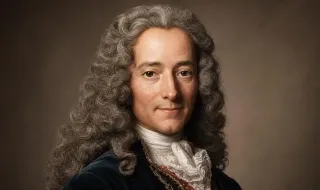
Voltaire was born in Paris as François-Marie Arouet. The date traditionally observed is November 21, 1694, but it is surrounded by a curious mystery: in his later years, he himself insisted that he had been born on February 20. The record of his baptism is dated November 22, while historians consider November 21 the most likely date of his birth. Thus, today marks 332 years since the appearance of one of the most recognizable voices of the Enlightenment.
From Arouet to Voltaire
The future philosopher studied at the Jesuit Collège Louis-le-Grand and was initially steered toward a career in law. Literature, however, proved stronger than his family’s plans. In 1718, following the success of his first tragedy, “Oedipus,” he began using the name Voltaire.
The new pseudonym did not protect him from trouble. In 1717, he was imprisoned in the Bastille for satirical poems attributed to him. He spent nearly 11 months there. In 1726, he was detained again after a conflict with the aristocrat Guy-Auguste de Rohan-Chabot. To avoid another imprisonment, Voltaire left for England and stayed there for nearly three years. The experience changed the direction of his thinking: he became more deeply acquainted with the ideas of John Locke and Isaac Newton, and later introduced them to the French public.
A Philosopher Who Knew How to Make Money
Voltaire did not rely solely on his literary talent. In 1729, together with the mathematician Charles Marie de La Condamine, he took part in a scheme that exploited an error in the calculation of prizes in the state lottery. His winnings are estimated at nearly half a million livres. The money gave him independence and the opportunity to write, travel and maintain a wide network of correspondents.
For around 16 years, Voltaire was close to Émilie du Châtelet – a writer, mathematician and physicist. At her estate in Cirey, he worked on historical and philosophical writings. Du Châtelet translated Newton’s “Mathematical Principles of Natural Philosophy” into French – a translation that remained important for the spread of his ideas in France.
“Candide,” Calas and the Battle Against Intolerance
Voltaire’s best-known work today is “Candide,” published in 1759. The book was also inspired by the 1755 Lisbon earthquake, which called into question the optimistic idea that we live in “the best of all possible worlds.” At the end of the satirical novella, the hero arrives at a brief conclusion: “We must cultivate our garden.” The phrase became one of Voltaire’s most recognizable messages – a call for practical action instead of empty explanations.
The philosopher also intervened in specific cases of injustice. The most famous is the “Calas” case – the Protestant Jean Calas was convicted and executed in 1762 on charges of murdering his son. Voltaire campaigned for the case to be reviewed, and in 1765 the verdict was overturned. The case inspired “Treatise on Tolerance,” in which he attacked religious fanaticism and defended the right to a fair trial.
Voltaire was elected a member of the French Academy in 1746, lived for some time at the court of Frederick II and spent his final years in Ferney, near the French-Swiss border. The complete critical edition of his works, completed in 2022, comprises 205 volumes – a scale that shows why his name remains associated not only with “Candide,” but also with poetry, theater, history, journalism and political polemics.
Sources: history.com, theguardian.com