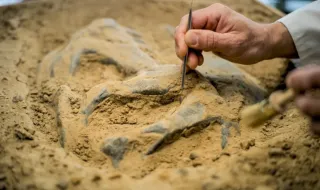
A fossil considered to represent an already known species sat for years in a museum drawer in Chicago. A new study has shown that the specimen belongs to a previously unknown ancient amphibian that lived around 309 million years ago — long before the appearance of the dinosaurs.
The species has been named Jeanerpeton mazonensis — “Jean’s creeping creature from Mazon Creek.” The name honors the mothers of the two students who led the research — Peyton Kolbarg and Allison Sefkowicz, both of whom are named Jean. The results have been published in the scientific journal Journal of Vertebrate Paleontology.
The fossil even preserved the imprints of its eyes
Jeanerpeton mazonensis is an early relative of modern amphibians. In appearance, it likely combined features of a salamander and a frog — it had an elongated shape but a short, stocky body.
The fossil was discovered years ago by an amateur collector and was later donated to the Field Museum of Natural History in Chicago. When it was initially identified, scientists classified it as Amphibamus grandiceps — a group in which similar specimens had historically been collected without all of their anatomical differences being distinguished.
“What is truly remarkable about Mazon Creek is that it preserves all these unusual details — things like toe pads and body contours,” explains Allison Sefkowicz, co-lead author of the study. According to her, the fossil reveals scales along the back, miniature “belly ribs,” known as gastralia, as well as imprints of the eyes.
Old museum collections conceal new species
A detailed reanalysis of the skull and skeleton showed that the animal differed from the other known members of the group. This provided grounds for removing it from its previous classification and officially describing it as a separate genus and species.
“We have now found enough evidence that this is an anatomically distinct animal, and we are officially removing it from that group,” says Kam So, a co-author of the study.
The area around present-day Chicago was a warm, swampy river delta during the Carboniferous. The rapid accumulation of sediment at Mazon Creek helped preserve fine details of the body that would normally disappear during fossilization. According to the researchers, the find also shows that museum collections can reveal new species even without new excavations.