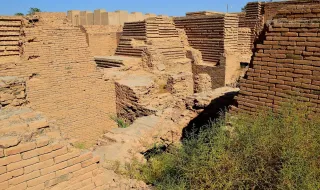
The fall of the Old Babylonian kingdom likely took place around 1587 BC. This is shown by a new study that combines analysis of annual rings in ancient wood, radiocarbon measurements, Babylonian astronomical records and data from polar ice cores. The results support the so-called Middle-Low chronology of ancient Mesopotamia.
The study, led by Charlotte Pearson of the University of Arizona, concerns the capture of Babylon by the Hittite king Mursili I. It should not be confused with the fall of the Neo-Babylonian Empire to the Persian king Cyrus the Great in 539 BC.
Wood links archaeology to the calendar
The scientists examined wooden beams from palaces in Kültepe and Acemhöyük, located in modern-day Turkey. Carbon-14 levels were measured in each annual ring, and the resulting values were compared with data from trees whose calendar ages had already been established. The study included 735 new measurements.
The outer rings show when the trees were felled. The beams from the Warsama Palace in Kültepe have been dated to 1837–1836 BC, while the wood from the Sarıkaya Palace in Acemhöyük dates to around 1778 BC. These dates are linked to clay tablets discovered in the same archaeological contexts, which contain information about rulers and events.
Volcanic traces help select a chronology
The next step was to compare ancient observations of Venus with evidence of volcanic eruptions preserved in polar ice cores. The strongest match is with the eruption of the Aniakchak volcano in Alaska around 1628–1627 BC. According to the researchers, this correspondence helps determine which of the competing chronologies of Mesopotamia is best supported by the data.
„The remaining uncertainties provide strong support for the Middle-Low chronology“, the study's authors write.Under this model, the fall of Babylon is placed around 1587 BC. The wording „around“ is important, as the study proposes the best-supported time frame rather than an exact day or month for the capture.
The method opens the way to other disputed dates
The authors connect the results to a broader chronology covering approximately the period from 2000 to 1587 BC. This framework is significant not only for Mesopotamia but also for the histories of Anatolia, northern Syria, Egypt and the Aegean world, which were linked through trade, diplomacy and warfare.
The same tree-ring data also indicate an unusually dry period between 1228 and 1188 BC, including a severe drought in 1194–1192 BC. It preceded the destruction of the Hittite capital Hattusa by two years. The scientists cite this coincidence as grounds for considering climatic conditions a possible factor in the crisis of the Hittite Empire, without identifying them as the sole cause.
Sources: phys.org, iflscience.com, archaeology.org