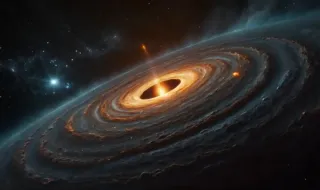
Astronomers have discovered the most distant known quasar – the bright core of a galaxy powered by a supermassive black hole. The object J1504+6252, named Dun Aongasa, is seen as it was just 630 million years after the Big Bang. This means its light traveled for around 13.1 billion years to reach Earth.
At the center of the quasar is a black hole with a mass around 360 million times that of the Sun. The discovery improves on the previous record for the most distant quasar by around 40 million years and is the first confirmed observation of a quasar with a redshift above 8.
„This time, the leap back in time is enormous!“, said the study's lead researcher, Julien Wolf of the European Southern Observatory.The Discovery Begins with a Small Red Dot
Dun Aongasa was discovered in data from the wide survey conducted by the Euclid space telescope, which observed millions of objects over around 18 months. The initial signal was checked with ground-based and space observatories. The Keck, Large Binocular Telescope and Hubble telescopes provided the first confirmations, while spectroscopic observations with James Webb established the redshift z = 8.13 and the mass of the black hole.
Quasars form when gas and other matter spiral around a black hole and heat up until they emit radiation brighter than that of an entire galaxy. This bright emission allows astronomers to detect such objects from the earliest epochs of the Universe.
The Black Hole Grew Too Early
The biggest question is how a black hole with such a mass could have appeared so soon after the beginning of the Universe. According to the team, the observations are consistent with a scenario in which a huge gas cloud collapsed directly into a black hole, rather than the black hole beginning as a small stellar remnant.
At the time of observation, Dun Aongasa was absorbing matter relatively slowly. If it had always grown at this rate, it would have had to start as an unusually massive „seed“, which is difficult to explain with existing models. The researchers therefore suggest that early in its life, the black hole went through much faster phases of matter accumulation.
The results were published in the journal Astronomy & Astrophysics. According to the scientists, future observations with Euclid and James Webb could discover even earlier quasars and show whether the direct collapse of gas clouds is sufficient to explain the appearance of these giant black holes.
Sources: apnews.com