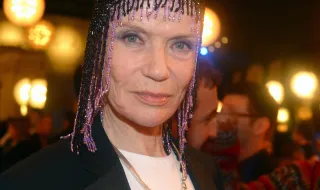
Veruschka, one of the first faces of global fashion, died on November 24 in Berlin at the age of 87. The news was confirmed by the German news agency DPA, citing sources close to the family. The cause of death was not disclosed.
Born Vera Gottliebe Anna Countess von Lehndorff-Steinort on May 14, 1939, in Königsberg, East Prussia, she became an international star in the 1960s. Under the name Veruschka she worked with photographers such as Richard Avedon, Irving Penn and Helmut Newton, while the American edition of “Vogue” magazine featured her on its cover 13 times. At the height of her career, the model was among the highest-paid in the world, earning up to $10,000 a day.
A scene in “Blow-Up”
Veruschka’s fashion fame extended far beyond the pages of magazines. In 1966, she appeared as herself in “Blow-Up,” a film by Italian director Michelangelo Antonioni. The brief scene featuring her became one of the iconic moments of 1960s cinema and cemented her image as a woman who both represented and expanded the boundaries of the fashion industry. She later also appeared in the 2006 film “Casino Royale.”
Veruschka was more than just a model. In the 1970s, she gradually moved away from the traditional fashion business and turned her attention to photography and visual art. In collaborative projects with photographer Franco Rubartelli and artist Holger Trülzsch, she used body art to transform her own body into an ever-changing artistic image.
A family history marked by resistance
Her life was also connected to one of the darkest chapters in German history. Her father, Heinrich von Lehndorff-Steinort, was executed by the Nazi regime for his involvement in the resistance and the July 20, 1944, plot. After his arrest, Veruschka and her family were persecuted.
“We mourn an extraordinary woman, Katharina’s sister, and an artist who from the very beginning left her mark on our house,” her relatives said in a statement quoted by ORF.
Veruschka remains in history as a model who transformed the profession from displaying clothes into an independent artistic role. Her image continues to feature in the archives of fashion, the history of cinema and the development of body art.