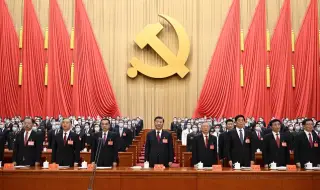
September 3, Beijing was the place to be " any self-respecting ambitious dictator.
In an apparent attempt to challenge the United States, Chinese President Xi Jinping invited his friends Vladimir Putin (Russia), Kim Jong-un (North Korea), Alexander Lukashenko (Belarus), Massoud Pezeshkian (Iran), and Min Aung Hlaing (the head of the Burmese junta), among a host of other statesmen, to a grand military parade in Tiananmen Square to mark the 80th anniversary of the end of World War II and the victory over Japan.
While their countries are under heavy Western sanctions, these "strongmen" tried to create a semblance of unity by watching the latest tanks, missiles and drones parade under the protection of their Chinese patron.
It is symbolic that this was the first time in history that Xi Jinping, Vladimir Putin and Kim Jong-un, all three nuclear-armed statesmen, stood side by side in the same place, notes the French newspaper L'Express in its article on the subject.
Victory for Putin
The trio of autocrats may be tempted to raise a glass to Donald Trump. Because even if the latter's unpredictability inevitably worries them, they can thank the American president who, without seeming to realize it, is showering them with gifts.
In Alaska on August 15, the whole world witnessed this: the occupant of the White House literally rolled out the red carpet for the Kremlin leader, welcomed him with to thunderous applause and put him in his limousine.
In this way, he legitimized the Ukrainian executioner without any compensation, brought him out of his international isolation and fulfilled Vladimir Putin's dream of returning to the good old days of the Cold War, when global geopolitics was regulated by summits between the two superpowers - the United States and the USSR.
The Kremlin's propagandists were very pleased, especially after the American president, who had previously repeatedly blamed Kiev for starting this war, agreed to discuss a peace plan for Ukraine with Putin without providing a ceasefire in advance.
This was a complete reversal of the policy of Donald Trump, who threatened Moscow with serious sanctions if the truce failed on August 8, but never fulfilled his ultimatum. Since then, Russia has continued to bomb Ukraine, and its president has achieved his goal: to buy time.
"Although Putin already knows that his ambitious Plan A, "...in which Trump would simply impose an agreement drafted in Moscow on Kiev is unlikely to materialize, he turned to his more realistic Plan B, in which Trump would lose patience and significantly reduce US aid to Ukraine," wrote Alexander Gabuev, director of the Carnegie Russia Eurasia Center in Berlin, in an article for Foreign Affairs magazine. He added: "By the Kremlin's calculations, this is still a victory."
Trump's trade war has backfired
Washington has also shown surprising generosity towards China, which the United States considers its number one rival. In early August, after promising a new tariff hike if a trade deal with Beijing was not reached by that date, Donald Trump postponed the deadline by six months, despite the lack of any progress.
Earlier, in mid-July, he lifted a ban on American companies exporting chips to China, which are essential for the development of artificial intelligence, a key sector in the race for global dominance.
Clearly, China's threats to supply rare earth elements, which it has virtually monopolized, have made Washington think twice. It is as if the trade war he started has turned against the US president himself.
"The Trump administration's approach to China appears to be largely in favour of Beijing, which has successfully demonstrated that it can inflict significant losses on the United States", analyzes William Matthews, an analyst at Chatham House.
"Ultimately, China's dominance in the rare earth supply chain gives it leverage even in areas where the US has an advantage, such as in the production of advanced electronic chips. The US simply does not have the same leverage over China that it has over its allies, in particular the EU", Matthews points out.
Another source of satisfaction for Xi Jinping: by imposing excessive tariffs (50%) on imports of Indian products, Donald Trump is pushing New Delhi into Beijing's arms. Until now, the US strategy has been to strengthen cooperation with India to counter China and isolate it.
In a sign of a noticeable warming of relations after several years of high tensions, Indian Prime Minister Narendra Modi will hold a one-on-one meeting with Xi Jinping at the Shanghai Cooperation Organization summit in Tianjin (which brings together China, Russia, India, Pakistan and Central Asian countries). The two leaders have not met since 2018.
Deep down, although he recently denied it, Donald Trump has always envied dictators.
"He has a natural affinity for autocrats because he envies them. Let's not forget that he is a businessman: he is used to everyone obeying him when he makes decisions", recalls Charles Kupchan, a former adviser to Barack Obama and a professor at Georgetown University in Washington.
"But when you are the president of a democratic country like him, you have to deal with the Senate, the House of Representatives, the agencies, the media..." The former entrepreneur has repeatedly expressed his admiration for the iron fist of Vladimir Putin and Xi Jinping. When the Russian president declared the independence of two regions of Donbas, shortly before the invasion on February 24, 2022, he called it "a move of genius". And after his Chinese counterpart, whom he considers "one of the smartest people in the world", amended the Constitution to allow him to remain president for life in March 2018, he did not hide his enthusiasm.
"Maybe one day we should try that," Trump said provocatively. And this week, as he hosted the South Korean president in the Oval Office, he had only his enemy Kim Jong Un on his mind. Donald Trump insisted that he had "a great relationship" with the North Korean leader (previously described as "very honorable") and that he wants to meet him again.
Beyond flattery, the MAGA leader is weakening America's soft power by harassing its historic allies, imposing tariffs even on poor countries, and demonstrating his contempt for international law and Western values.
His position, in particular, plays into the interests of Xi Jinping, who dreams of reshaping the world order in his favor.
"To achieve this, the Chinese president must demonstrate that the current system is broken and that it must be changed, with the support of the Global South and under Chinese leadership," sums up Steve Tsang, director of the SOAS China Institute at the University of London.
"No one has done more to discredit US global leadership and the liberal international order than Trump in just over seven years. months", he added.
The fact that the former real estate developer has retained his businesslike approach also gives Vladimir Putin and Xi Jinping leverage over the American president, who is more likely to sign agreements than his counterparts.
"Trump does not have a geopolitical vision of the world; he sees it through an economic prism. When he negotiates to end the war in Ukraine, he thinks about the markets that would open up for American companies and about oil and gas purchases", emphasizes Charles Kupchan.
"Similarly, Donald Trump does not spend his time wondering whether Xi Jinping will invade Taiwan; if he has sleepless nights, it is because of the trade deficit between the United States and China. "Trump is taking many steps that surprise and delight China: he is not giving any importance to ideology, which is exactly what China has been hoping for for years," adds Yun Song, an expert on Chinese foreign policy at the Stimson Center in Washington.
"He is taking this approach because he sees trade as his top priority, not national security. "But resolving the trade imbalance requires China's cooperation," he added.
"I'm not a dictator," Donald Trump defended himself last month after ordering the deployment of the National Guard to Los Angeles in June and then to Washington, the federal capital, in mid-August.
The very fact that the American president, once called the "leader of the free world," feels compelled to deny such an accusation is in itself astonishing.
His autocratic friends are certainly pleased with his consistency.