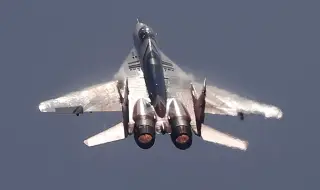
Putin constantly provokes the West. First with drones over Poland, then with fighter jets in the airspace of Estonia. The result: NATO is holding consultations in accordance with Article 4 of the organization's Charter. And Estonia has demanded that the incident with the Russian MiG-31 fighter jets be considered by the UN Security Council.
The fact that drones are spying on the Bundeswehr barracks and naval vessels are scouting the location of cables and pipelines in the Baltic Sea is not news. The reaction of Western countries has also always been usual: a note of protest, summoning the ambassador to the Foreign Ministry - and nothing more. However, it has always been clear: such actions by Russia are an act of aggression. That's exactly how they were intended.
Now NATO is sending a clear signal: this is coming to an end.
Should Russian fighter jets be shot down over NATO territory?
The crucial question is: how to react? Jürgen Hart, an expert in the CDU/CSU parliamentary group on foreign policy, is calling for a clear message to Moscow. In future, border violations should not go unpunished - in the extreme case, Russian fighter jets could be shot down.
Germans have different opinions on the matter. And among my friends and acquaintances, it's like this: some find this consistent and correct, others warn that it would be a violation of a taboo, showing that Germany is preparing for war with Russia.
But what appears to be a violation of a taboo would ultimately be nothing more than a defensive measure. In 2015, Turkey showed that such a reaction can have an effect. Then it shot down a Russian fighter jet that entered Turkish airspace from Syria. Since then, Putin has not touched Turkey.
But can this scenario be realized today? After three and a half years of war in Ukraine, the situation is more unstable than ever. Now it is hardly possible to judge unequivocally whether the destruction of a Russian plane will be perceived as a signal of restraint or as an occasion for the next stage of escalation. Putin's strategy is clear: he is increasingly pushing the boundaries of what is permissible until Europe is confronted with the reality of military confrontation. At some point, the point of no return will be reached.
Some believe that Putin will not enter into contact with NATO. But why not? He has been doing this for a long time. What else would the incidents in Poland and Estonia be for, if not to test the Alliance's reactions?
2025 has changed the rules of the game
With the return of Donald Trump to the White House, the geostrategic coordinate system has changed. The US expects Europe to solve its own problems. It is ready to make a deal with Putin instead of supporting Ukraine. Putin skillfully used this change of course for his own interests and has now set his sights on Europe.
Europeans can continue to applaud themselves for their response to the drones over Poland. But the fact that fighter jets were forced to fire missiles worth millions of dollars at cheap, disposable drones raises doubts about whether Europe's defense capabilities are up to the challenge.
Europe needs both a policy of containment and diplomacy
It is entirely justified that Europe adopted a large-scale rearmament program this year so that it can defend itself without the help of the United States if necessary. It is also absolutely true that a clear signal is needed now that provocations such as drones over Poland and fighter jets over Estonia must be stopped immediately.
On the other hand, Europe still does not have enough diplomatic initiatives. The US president's attempt to end the war in 24 hours failed. Trump was - and probably still is - ready to make serious concessions at the expense of Ukraine. But Putin has thwarted all peace plans.
However, along with deterrence, diplomatic steps are still needed. After all, what is the alternative? The history of the 20th century teaches us that the spiral of arms race, mistrust, provocations and retaliation will only spiral ever stronger – until the accumulated weapons are used. But this must not become the next chapter in the history of the current confrontation.
Author: Dirk Emmerich