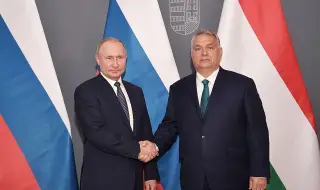
Hungary constantly vetoes or threatens to veto important EU decisions - especially on Ukraine. This complicates common foreign policy. How could Orbán's blockade be ended?
Leaving the coffee room, complex legal constructions on interest on frozen Russian assets, closing statements by European leaders without Hungarian Prime Minister Viktor Orbán - such examples show how EU countries have made decisions without Hungary's participation or in an attempt to bypass the country.
However, in foreign and security policy, this is becoming increasingly difficult. The sanctions packages against Russia, the 19th of which is currently under discussion, must be approved by all member states. Decisions on tax policy or the admission of new members to the EU could also be blocked by an individual country with its veto.
"Morally, this is not reprehensible", Nikolai von Ondarza from the Berlin-based "Science and Politics" Foundation told DW. Ultimately, this also touches on the issue of national sovereignty. And when it comes to their own interests, countries do not want to be ignored, explains the political scientist who heads the foundation's EU research group. In the case of Germany, this applies, for example, to EU policy towards Israel.
According to Ondarza, the problem with Hungary is that the country is often not interested in the cause itself. In that case, it uses its veto power to "blackmail" member states on other issues.
In EU jargon, this is called a "tactical veto". Especially with regard to Ukraine, the Hungarian prime minister often blocks EU policy. This means that aid to Ukraine from the European Peace Facility, amounting to around 6.6 billion euros, cannot yet be disbursed. Budapest is also opposed to Ukraine's possible accession to the EU. It cites, among other things, fears that this could drag the EU into a war with Russia. However, Orbán's government ultimately approved all 18 packages of sanctions against Russia adopted so far.
It is rare for other member states to use such tactics, says Nikolay von Ondarza in this regard. For example, Cyprus blocked sanctions against Belarus in 2020 in order to achieve tougher measures against Turkey.
ADVERTISEMENT
Foreign ministers want to discuss working methods
The EU has a constitutional problem, Danish Foreign Minister Lars Lokke Rasmussen said at an informal meeting in Copenhagen in August. "The slowest ship in the convoy sets the speed. And we need to find ways in which the majority in Europe can impose its position." That is why the EU must look for "innovative solutions". However, the meeting in question did not discuss what these working methods could be.
As early as 2023, a "Group of Friends to Improve Decision-Making in the Field of Common Foreign and Security Policy" was established at the initiative of Germany. According to the Council of the EU, 12 countries are already participating in the initiative: in addition to Germany, these are Belgium, Denmark, Finland, France, Italy, Luxembourg, the Netherlands, Romania, Slovenia, Spain and Sweden.
The "Group of Friends" has proposed that certain decisions, such as those on sanctions or the sending of civilian missions, be adopted by qualified majority. This is the case when at least 15 member states, representing at least 65% of the EU population, give their consent. A kind of safety net (guarantees) regarding the national interests of the member states is also envisaged. However, proposals such as this must be approved by all 27 EU heads of state and government.
In her State of the EU speech at the beginning of September, European Commission President Ursula von der Leyen also spoke in favor of changing the current decision-making mechanism in order to avoid blockages. In some areas, the EU needs to break free from the "shackles of unanimity" of 27 votes, she urged.
A treaty change is possible, but unlikely
Another option for weakening the principle of unanimity in the EU is a change to the EU treaties, which could be undertaken, for example, in the context of the accession of a new member state, says Nicolai von Ondarza. This would also require the agreement of all 27 member states. That is why the political scientist considers such an agreement "politically unlikely" at the moment.
However, if the "group of friends" continues to grow, it could put more pressure on other countries to force decision-making by majority vote instead of unanimity at a later stage. According to Nikolay von Ondarza, however, this could mean that the EU will have to pay a very high price to Hungary to give up this powerful trump card.
In Brussels, the "group of friends" is also seen as a means of exerting pressure, DW learned from a European diplomat. According to him, Hungary is increasingly isolated. The European Commission is currently working on a plan to use frozen Russian assets for the reconstruction of Ukraine. As reported by the Reuters news agency, the EC has been looking for ways to circumvent the Hungarian veto from the very beginning.