Veselin Stoynev's comment:
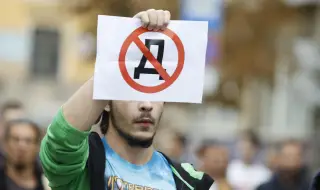
There are many prerequisites for the massification of the protests of the democratic community, but this does not mean that it will necessarily happen. And so far it is not happening, although the protest wave began in the summer, but for the whole of September the protest demonstrations, mainly in Sofia and Varna, have not been particularly large-scale. However, there is a certain desire for this, and calls for radicalization from the spokespersons of the protests are becoming more frequent. There is also a desire for the consolidation of civil and party formations, such as the square initiative taken by the "Boec" association at the protest on Thursday evening - for national unity against the mafia.
The prerequisites for mass protest
The main prerequisite for mass protest is that the government becomes increasingly intolerable for more and more people. Intolerable because of injustice, backstabbing, corruption, illegitimate takeover of institutions. For many people, the situation is exactly that, but for only a part of them it is intolerable. Something needs to "light the fuse" so that the intolerable can become unbearably disgusting. So disgusting that it does not only cause disgust and contempt, but anger that can spontaneously bring thousands to the streets. What is needed is a disgusting irritant who, with his increasingly disgusting words and actions, is the target of this anger. And especially a person as the focus of the unbearable disgusting.
As in 2013, the target is there - the person Delyan Peevski. He is making every effort to be the limitless irritant, declaring himself the autocrat of the entire state. The escalation of the irritant should give rise to an escalation of the protest, and this means not so much that it be weekly or daily, as that it expands its scale.
Who can start the protests?
Protests are organized or initiated by someone. The less the organizers of the protest declare themselves as leaders and the more unencumbered their biographies are, the more spontaneous the protest is. As was the case with the protests in 2013 against the "Oresharski" cabinet and against the appointment of Peevski as head of the National Security Agency, organized on Facebook without leaders. And as the protests against the government of Aleksandar Vučić that broke out last year in Serbia, led by students - people with "clean biographies" due to their youth, are less likely today to provoke the kind of angry spontaneity that would lead to a scale that would be respectful to the ruling party. Moreover, not only between the civic and party leaders and formations, but also within the two groups, serious contradictions and rivalries are barely concealed or directly shouted out from the microphone. Although politicians and parties do not stand on the front lines of the protests, civic spokespeople often taunt them for not being radical enough, calling on them to swear by the pure protest faith to the end, and some even allow themselves to speak on behalf of the entire citizenry against the parties. When the parties do not join a protest and it turns out to be quite small, civic activists accuse them of passivity and even collaboration with the ruling party, again on behalf of the citizens, whom they otherwise manage to attract to the squares only on a modest scale.
The PP-DB parties, on the other hand, have serious differences in the extent to which the forms and methods of protest demonstrations extend - some of them, for example, shy away from occupying or invading institutions and from publishing the telephone numbers and addresses of magistrates to exert civic influence.
The protests can and often have been a maternity home for new political leaders from the civil sector, for the rebirth of old ones who ended up in extra-parliamentary parties, or a station for recharging politicians from parliamentary democratic parties. Regardless of whether the speakers at the protests are driven by ideological or careerist motives, or by some acceptable mixture of the two, this inevitably gives rise to rivalry between them and garners assessments ranging from frowning suspicion to enthusiasm from the protesters. Most of the protesters are aware in most cases who the speakers are and what they can expect from each one, because ultimately they are from the same community - both as civil structures and as a party electorate. It is no coincidence that when the PP-DB parties are spoken out openly at a protest, boos are heard. And vice versa - when a party leader behaves too constructively in the square as a parliamentary opposition, he receives quite restrained approval, in contrast to the enthusiasm when a speaker directly calls for "sweeping them out".
Chances for the protests to expand
On the one hand, the protests of the democratic community suffer from the internal limitations of biographical burden - some were in the assembly, others experienced themselves as Robespierres, others climbed on the back of the protests to enter parliament. On the other hand, the familiar is a guarantee that there will be no added incomprehensible causes in the protests. It is no coincidence that a clear distinction is maintained from protesters from Russophile parties and care is taken for the emergence of completely new faces without biographies, who may turn out to be conductors of someone else's will, including those against whom the protests are being protested.
More massive and more spontaneous protests, such as those in our country in 2013 and those in Serbia, suffered from a lack of political physiognomy and political structure to quickly walk the path to an alternative to power. The current, more limited in scale, protests in Bulgaria have one, so that it is clear that if the street discontent succeeds, it will not be capitalized by anyone and for anything, but will impose a clear political program and its executors.
So the chance of the protests of the democratic community for massification is rather within the democratic community itself, which is now far from mobilized. The protest wave can be expanded, but only on the backbone of this community. There are many more people who would vent their anger against the disgusting, but their energy should be directed only towards that with which it can be replaced, so that it is not wasted or replaced.