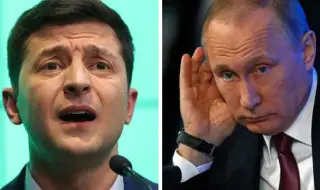
"Ukrainian drone attacks lead to refineries shutting down for days, weeks and even months": Kiev's new strategy is clearly working and affecting the Russian economy. Will this force Putin to negotiate?
Donald Trump will meet with his Ukrainian counterpart Volodymyr Zelensky today, where he plans to talk about his phone conversation with Vladimir Putin. Zelensky, in turn, is likely to present the successes of the Ukrainian army, especially in the air war.
Ukraine continues to attack the core of the Russian economy - the oil and fuel sector - with drones and missiles. This was the case last night, ARD writes. A burning refinery in Saratov, a city located over 500 km from the border.
Ukrainian military expert Ivan Stupak told the NV portal: "These actions are systematic". Since August, Ukraine has been carrying out attacks on the Russian oil sector on a large scale, and since October - on the power grid, Stupak points out. "In the Russian region of Volgograd, a very large power grid was just hit, with the help of which electricity from a hydroelectric power plant reaches the central regions of Russia."
The Russian economy is in the crosshairs
These attacks differ from Russian attacks on the Ukrainian energy system, Stupak believes. Their goal is not to make life difficult for Russians - to a much greater extent, the idea is to affect the Russian economy, including the arms industry. And this is being implemented successfully, expert on the subject Andrey Gurkov told ARD. "Ukrainian drone attacks are causing refineries to shut down for days, weeks, even months."
We can easily imagine what happens to an economy that doesn't get enough fuel, Gurkov told German public media. This is a problem above all for logistics. "In a country as big as Russia, logistics, i.e. trucking, plays a very big role."
What could force Putin to sit down at the negotiating table?
The strategy of the Ukrainian attacks coincides with the rhetoric of the US administration in recent weeks - that the Russian economy must be weakened in order to force Putin to negotiate.
Under the previous US President Joe Biden, the US wanted Ukraine to refrain from long-range strikes deep into Russian territory. The Biden government even banned such strikes from being carried out with weapons containing components from the United States, ARD recalls.
The current American government's position is different. The British "Financial Times" recently wrote that the United States is now providing Ukraine with satellite data that, among other things, makes attacks on Russian refineries possible.
"Tomahawk" as a means of pressure?
Observers in Ukraine hope that Trump will take the next step by providing Ukraine with long-range "Tomahawk" missiles. Although he has been giving signals in this direction, the American president has been much more reserved after his last conversation with Putin. "We need "Tomahawk" in the United States too," he commented. "I don't know what we can do about it.
"Tomahawk" has much greater strike power than the drones and missiles that are produced in Ukraine. Trump has previously mentioned that he is considering supplying "Tomahawk", notes ARD. In talks with Zelensky, the Ukrainian president will probably try to convince him. "We see and hear that Russia is afraid that the Americans will give us "Tomahawk", Zelensky recently commented. "This kind of pressure can lead to peace."
If Washington makes this decision, it will be key. "This is how the Trump administration is really increasing pressure on the Kremlin for the first time," says Ukrainian military expert Oleksandr Musienko. In this way, the US is sending a signal to Putin that it cannot both continue the war and lie to Trump and the whole world that it actually wants negotiations. Musienko is convinced: "If Putin does not change his position, the US will move to the next stage and actually provide Ukraine with these missiles."
However, the US is about to resume top-level talks with Russia, with Trump announcing that he will meet Vladimir Putin in Budapest. Is the reason Putin is ready for talks the Ukrainian strikes or the threat of the "Tomahawk"? It is probably a combination of both, summarizes Florian Kellermann of ARD.