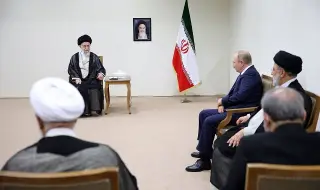
Iran is under intense international pressure over its nuclear program, and at the same time, Moscow is expanding its nuclear cooperation with Tehran. What geopolitical calculations lie behind the official partnership?
On November 20, the International Atomic Energy Agency (IAEA) called on Iran in a resolution to begin “immediately and fully“ cooperating with its inspectors. The agency wants to clarify the whereabouts of about 400 kilograms of 60% enriched uranium that the country still stores in an unknown location.
Following the 12-day war between Israel and Iran in June, Tehran denied IAEA inspectors access to the attacked facilities. While this dispute continues, Moscow is expanding its nuclear cooperation with Tehran. “Our cooperation has reached an unprecedented level”, said the Russian ambassador to Tehran, Alexei Dedov, in mid-November. He was quoted by the Iranian news agency ISNA as saying that Moscow supports and will continue to assist Tehran in finding solutions to the problems related to its nuclear program.
"Moscow has promised a lot, but has delivered little"
In late September, Moscow and Tehran signed a declaration of intent to build new nuclear facilities. The Russian atomic energy agency “Rosatom“ concluded with the Iranian company “Iran Hor“ a $25 billion contract to build four new nuclear power plants in Iran.
“Russia is the most important international partner for the Iranian nuclear program“, said Middle East expert David Jalilvand in response to a query from DW. Jalilvand runs Orient Matters, a Berlin-based consultancy specializing in geopolitics, economics and energy issues in Iran and the Middle East.
“When it comes to further expanding Iran's nuclear program, Moscow has so far promised a lot but delivered little“, he says.
The construction of a second reactor in Bushehr was announced back in 2016. To date, however, this has not been implemented. He considers it unlikely that the new declaration of intent will be implemented with concrete content: “Russia has no interest in strengthening Iran's strategic position in the Middle East, including because of its relations with Israel, the Gulf countries and Turkey“, says Jalilvand.
Russia did not help Iran during the 12-day war
During the 12-day war between Israel and Iran in June, Tehran received almost no support from Moscow. And according to the strategic partnership agreement signed with Russia at the beginning of the year, Iran should be able to count on military and economic cooperation for the next 20 years.
Tehran supplied drones and weapons for Russia's aggressive war against Ukraine and thus became one of Moscow's most important supporters - at the expense of its relations with Europe. In return, Iran ordered, among other things, several Sukhoi Su-35 fighter jets to modernize its air force. But until the recent military conflict with Israel, these aircraft were not delivered. The war clearly exposed the weaknesses of Iran's air defenses.
“The strategic agreement with Russia turned out to be a farce“, criticized Mohammad Sadr, a member of Iran's influential Expediency Council. “Russia is not reliable: it is absurd to believe that it will support us or stand up to the United States.“ Sadr even accused Moscow of providing Israel with information about Iranian defense centers.
In Iranian society, the image of Russia is correspondingly negative. A professor at Tehran University explained to DW: “People know that Russia abandons Iran at crucial moments. Many are convinced that the government is sticking to Moscow only to preserve its power, and not in the interests of the people“.
Behind the partnership are calculations
Despite the experience of the 12-day war, conservative forces in Iran demand further deepening of cooperation. “Russia's influence over the government in Iran is undeniable“, said Afshar Soleimani, former Iranian ambassador to Baku, in an interview with DW. “Conservative forces support Russia, the delivery of Iranian drones to Moscow and the ongoing tensions with the United States. This shows how strong this influence is. As long as this political current remains in power, little will change – the consequences will continue to be borne by the people.“
Kamran Ghazanfari, a member of the Iranian parliament, even claims that according to former Russian President and current Deputy Chairman of the Russian Security Council Dmitry Medvedev, Russia is ready to supply Iran with nuclear weapons. But expert Jallivand considers such a prospect extremely unlikely: “Russia has no interest in expanding the circle of nuclear forces in the already unstable Middle East.“
Delivery of military technology?
However, it is possible that Moscow will deliver technology that Tehran could theoretically use for a military program. Direct assistance in building an atomic bomb, however, is considered out of the question. Russia uses the “Iran card“ mainly as part of its negotiating strategy towards the United States. Although Tehran has reportedly temporarily halted uranium enrichment, it remains unclear whether Moscow will be able to persuade Iran to reduce its uranium stockpile.
“Russia has repeatedly presented itself as a mediator in the past,“ says Middle East expert David Jalilvand. “However, this is probably not motivated by an interest in resolving the nuclear conflict. Rather, given the war in Ukraine, Moscow is trying to position itself as a supposedly constructive partner to the United States and thus drive a wedge between Washington and Europe.“