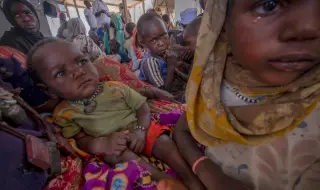
The ongoing war in Sudan is the most ignored global crisis of 2025, according to a joint study by 22 humanitarian organizations. The conflict-torn country also ranked first in a ranking of crises the world cannot ignore in 2026, published by the International Rescue Committee.
The situation in the African country has worsened in the past year, even though the war began in April 2023. The UN and other organizations call Sudan the world's largest humanitarian crisis. According to the UN, about 14 million people have been internally displaced within Sudan or in neighboring countries. Estimates put the death toll at between 40,000 and 250,000. "The crisis in Sudan should be on the front pages of every media outlet every day," says Abdurahman Sharif of Save the Children.
"A catastrophic situation is about to get worse"
Meanwhile, fighting between the Rapid Response Force (RSF) and the Sudanese Army (SAF) is concentrated in the Kordofan region, where the army controls several towns that the RSF paramilitary has besieged. Kordofan is the last region that separates the army-controlled parts of the country, including the capital Khartoum, from the territories under RSF control.
"Violence in Kordofan has escalated dramatically in recent times," says Jan Sebastian Friedrich-Rust of the German section of the organization "Action Against Hunger". According to him, the sieges of a number of cities are blocking humanitarian aid - people there have no food left, nor access to medicine.
The extremely difficult situation in Sudan is also reflected in the latest information from the Integrated Food Security Phase Classification (IPC), which reports that as of mid-December 21.2 million people - almost half of Sudan's population - are facing severe food shortages. The number is expected to rise after the World Food Programme announced that it would have to reduce the amount of food it sends to Sudan from January due to funding cuts.
"If the world does not take urgent action - diplomatically, financially and morally - an already catastrophic situation will worsen and millions of Sudanese and their neighbours will pay the price," said Mamadou Dian Balde, the UN refugee agency's regional director for East and Southern Africa.
Civilians are the target
Action Against Hunger's Friedrich-Rust fears Kordofan will follow the fate of Al-Fashir, where the RSF committed mass killings when it took over the area in November. The Humanitarian Research Laboratory at Yale University uses satellite imagery to monitor potential war crimes. According to them, the RSF "destroyed and covered up evidence of mass killings." Initially, 150 objects were identified that appeared to be human remains from satellite images. Nearly 60 of them are no longer visible.
"The truth is that both sides in the conflict and their allies are not just failing to protect civilians, they are directly targeting them - this is part of their way of waging war," says Philippe Damm of "Human Rights Watch". "Although most of the sexual assaults, attacks on hospitals and aid workers, and the use of explosives in densely populated areas are the work of the RSF, the army also commits serious crimes against civilians," he commented.
For example, the SAF is mass-detaining people it suspects of collaborating with the RSF, Damm explained to DW. These arrests also appear to have targeted aid workers. "We have also received many reports of people dying in SAF prisons, and we are seeing the return of the death penalty", says Dam.
According to the expert, it is high time for the European Union to do something - to take serious measures and address the crimes that both sides in the conflict continue to commit. "It is shocking to me that the leader of the RSF - General Mohamed Dagalo, known as Hemeti, continues to be unsanctioned by the EU despite his obvious connection to the crimes committed by the RSF," commented Dam. The expert also calls on Brussels to name the countries that support the conflict. While the SAF receives support mainly from Egypt, the RSF is said to be sponsored by the United Arab Emirates, although Abu Dhabi denies the connection.
EU aid is woefully inadequate
In December, the EU began transporting the first 100 tonnes of humanitarian aid to Darfur. The air corridor that is sending it will end at the end of January 2026 and is worth €3.5 million, which comes from the EU's humanitarian budget.
According to Jan Sebastian Friedrich-Rust, this is a good start, but in practice it is just a drop in the ocean. He notes that with the suspension of USAID and the reduction of foreign aid from a number of European countries such as Germany, many humanitarian programs in Sudan have been terminated. “The need for aid is enormous, but currently only 35% of the financial resources needed to implement it are available,” he comments.
Author: Jennifer Hollis