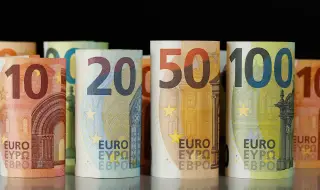
On the euro banknotes, the word “euro“ is written in three alphabets – Latin, Greek and Cyrillic – and they are visually distinguished by different typographic weights: bold, pale and very pale font.
This peculiar stratification in importance creates a clear suggestion of a hierarchy in which Latin script is a priority, and Greek and Cyrillic are marginalized as secondary and tertiary categories of scripts.
This was commented on "Facebook" by Valeri Grigorov.
In this sense, one can speak of demonstrated a mild form of symbolic discrimination and peripheralization of the scripts used in Eastern and Southeastern Europe. If for the Greek alphabet such peripheralization could be explained by objective considerations related to its limited contemporary geographical distribution, then the Cyrillic alphabet is a script used by over 250-300 million people and the bearer of a significant literary, scientific and legal tradition with a transnational and civilizational scope.
We must admit that the EU Institutionally does not know how to think in “civilizational“ categories: it does not recognize supranational scripts, does not take into account their global distribution and does not work with deep cultural and historical scales.
This explains why the Cyrillic alphabet “enters“ the symbolic order of the EU not as the Cyrillic alphabet, but reduced – as the Bulgarian script.
Its supranational, Slavic, Orthodox and Eurasian dimensions are deliberately weakened. Following a misconceived and almost sectarian political correctness, the EU depoliticizes and dehistoricizes the scripts with the argument of avoiding conflicting interpretations. As a result, the Cyrillic alphabet is reduced to a minimal formal institutional gesture towards Bulgaria, instead of being seen and recognized as a symbolically equal pillar of European civilization. In practice, a Latinocentric order is reproduced, in which other alphabets function only as supplements, and not as an equal basis of European civilization.
From this point of view, the secondary addition of the Cyrillic alphabet to the design of the Euro banknotes does not lead to a real understanding of the symbolic balance.
As a whole, the EU continues to suffer from a structural inability to think supranationally, despite its claim to be a supranational project.
This limited Latinocentric worldview continues to prevent Western European thinking from accepting the Cyrillic alphabet as a pan-European script and fully integrates it into the pan-European cultural genesis.
In a semiotic and institutional sense, the Cyrillic alphabet today functions more as an “uncomfortable sign“ in European identity, a sign that cannot be integrated without disrupting the dominant narrative and generating uncomfortable associations. In order to gain its rightful place as one of the foundations of Europe, the Cyrillic alphabet requires a rethinking of central categories, not just its formal addition.
First of all, the Cyrillic alphabet violates the simplistic civilizational scheme imposed as a description of European identity, which includes Greek philosophy and the political concept of democracy, Roman law, and the European Enlightenment.
This scheme legitimizes above all the Western European core, while at the same time excluding and marginalizing the Slavic-Orthodox civilization and its main written medium - the Cyrillic alphabet.
The main problem is that the Cyrillic alphabet builds on the cultural European identity with an alternative segment that is a product of the Byzantine-Orthodox world and is not a direct derivative of the Western one.
On the other hand, however, the Cyrillic alphabet is “too European“ to be exoticized. The paradox is that the Cyrillic alphabet is both “foreign“ to Western thinking and not foreign enough to be easily categorized as a convenient oriental exotic.
All this requires a serious intellectual effort on the part of the West to understand and accept the Cyrillic alphabet as internal to Europe – as a script organically linked to EU member states and as a bearer of an independent philosophical, legal and literary tradition.
Such a rethinking would only enrich the European identity by integrating the Slavic-Byzantine historical line and Orthodox culture and would make visible the parodic nature of the extremely sparing and peripheral inclusion of the Cyrillic alphabet, which is currently present only as a formal inscription - without a narrative, without historical density and without symbolic centrality in the pan-European cultural and linguistic design.
Although the EU was conceived as a project for the integration of the rich and diverse cultural, political and linguistic heritage of the European peoples, it still fails to make sense of and integrate the symbolic significance of the Slavic-Byzantine contribution to the genesis of modern Europe.
The management of diversity remains superficial, at the level of formal (technical) equality, devoid of historical meaning and cultural depth that would possess the understanding of “civilizational equality“.
This consciously sought symbolic minimalism, through the reduction of symbols, increasingly manifests itself not as an advantage, but as a structural deficit of the post-historical construction of Europe. The EU prefers procedural, formal and contentless identities: symbols without narrative, without history and without the need for interpretation.
Although the EU often speaks of “unity in diversity“, this diversity is understood mainly in a cultural-folkloric, not in a civilizational sense.
Local differences are allowed, but not a pluralistic history, in which Europe is formed by multiple civilizational centers offering alternative models of political and cultural organization.
If so far in the EU the monocentric model has not been recognized as a problem or as a veiled form of discrimination, then in the long term it risks deepening the asymmetry between the “normative center“ and the “historical periphery“. This questions the deep legitimacy of the European project and undermines the motivation for a shared and equal European identity.
Yet the current crisis of institutions and leadership in the EU can be seen as a good opportunity to rethink the imposed monocentric model and to formulate a new approach that fully encompasses the diversity of the European cultural space by recognizing multiple European genealogies and civilizational sources.