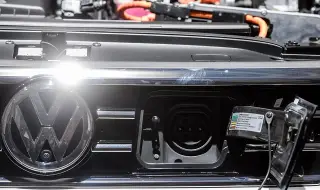
German cars have long been a symbol of reliability and technical excellence. But now sales are collapsing. Why?
A car that achieves a good time on the main stretch of the Nürburgring in Germany is certainly in excellent condition, explains to DW racing driver and influencer Misha Charudin. That is why all major car manufacturers have test centers on the track, built not least for this purpose in the distant 1927.
Brands such as Mercedes-Benz, BMW, Audi and Volkswagen, which used the track for their tests, have been a symbol of precise technology, power and reliability for years. These weren't just cars - they were cultural icons and the backbone of the German economy. But that magic is fading.
The first cracks and the fatal lag
The German car industry employed over 1 million people and was long a barometer of economic conditions. German manufacturers sold 200,000 cars in 1950; today, sales have reached 14 million worldwide. For decades, the formula for success was simple: world-class engineering plus global demand.
But the good times are over. Sales are falling, staff are being cut, and many factories are closing. "The pressure is on, everyone is cutting back" a Mercedes employee, who requested anonymity, told DW.
The first cracks appeared in 2015 with the scandal in which it was revealed that Volkswagen had cheated on emissions tests. The scandal cost the group more than 30 billion euros and destroyed confidence in German brands. But that's not all: it coincided with a global rethink in the direction of climate-friendly technologies. And while Tesla doubled sales of electric cars, German manufacturers were still hesitant.
How a hope for the future was lost
For years, China was Germany's main market. In the 1980s, Chinese politicians even invited Volkswagen to establish joint ventures and produce cars in China for the Chinese population. At times, the Wolfsburg-based concern achieved a market share of almost 50 percent there.
Other car manufacturers subsequently followed suit. And the more the Chinese economy grew, the bigger the Chinese car market became. Until a few years ago, German manufacturers sold one in three cars in China.
But China had a plan: to learn from its foreign partners and then take the lead. In 2009, Beijing passed a law to promote electric vehicles. "It wasn't necessarily about climate change, but about developing technology with which China could overtake its foreign competitors and prosper," Beatrix Kaim, who worked for Volkswagen in China for 20 years, told DW. According to her, German car manufacturers did not realize this development - and underestimated both the determination of the Chinese leadership and the pace of development.
Today Germany depends on China
Thanks to high subsidies in industry and infrastructure, China is today the world leader in the production of electric cars and batteries. "With electric cars, they had the unique opportunity to overtake Germany. And they did", China expert Manuel Vermeer told DW. Today, every second car sold in China is electric, and almost all of them are from Chinese brands. As a result, Germany's sales in its most important market have collapsed.
At the same time, Germany depends on batteries imported from China. "Even if we produce very good electric cars, we still need batteries from China. "We are even more dependent than before," Vermeer explains.
Can India fill the gap?
As China loses importance for German manufacturers, attention is turning to India, the world's most populous country. Could it become the next big player?
In the city of Chennai in southeastern India, German cars are rare - Indian, Japanese and Korean cars dominate the streets of the city, nicknamed the "Detroit of India" because of the many car factories located there.
BMW's Chennai plant produces only about 80 cars a day, but it is still growing by more than 10 percent a year. Plant director Thomas Dose told DW that the Indian market is attracting a lot of interest. "Everyone thinks: If we are not in India now, we will miss a big opportunity." But Dose is realistic. "Is India the new China? I wouldn't say so. India definitely has potential. But we won't see the kind of enormous growth that China has."
Experts agree. The Indian market is promising, but German carmakers face cultural obstacles. "We want to sell the best cars in the world, but our technical requirements are too high for Indian conditions. In India, 80 percent is more than enough. Our perfectionism is not optimal for this market," Vermeer explains.