The first month of the penultimate year of Emmanuel Macron's presidency was supposed to go in a predictable manner. In domestic politics, Prime Minister Sébastien Le Corneille was tasked with pushing the draft budget through parliament through compromise and without triggering an article of the constitution under which laws are adopted without debate in exchange for a vote of no confidence in the government. Foreign Minister Jean-Noël Barrot was tasked with making more categorical statements on topics on which Macron would not want to confront traditional partners, such as the issue of Syria, which is straining Turkey's relations with France. Macron himself had several key speeches planned for January – those before French ambassadors and before French military personnel, which are traditional for the beginning of each new year and which usually present the head of state's vision for the world. Macron was also scheduled to deliver a speech at the World Economic Forum in Davos. In addition, France's one-year rotating presidency of the G-7 began in January, which France took over from Canada. In January, Macron was also supposed to continue and deal with finding a solution to the war in Ukraine.
Due to unexpected foreign policy and health circumstances, things developed differently for Macron in the past month of January.
The month began with comments about the traditional New Year's speech of the French president, or more precisely, with questions about whether there is a need for such a speech, given that viewer interest in it decreases every year, notes “20 Minutes“. Two years ago, Macron's New Year's address, delivered at exactly 8 p.m. on December 31 and broadcast on a number of French television channels, was watched by 10.2 million viewers, and the following year it was watched by 9.7 million viewers. At the end of last year, 37 percent of French people said they did not plan to watch the New Year's address of a head of state, whose rating, according to the Toluna-Harris poll, was only 25 percent, the publication adds. In the end, Macron's New Year's address was watched by only 8.9 million viewers, according to the specialized publication Media Leader and the newspaper Le Figaro. It lasted only 10 minutes and was de facto Macron's shortest New Year's statement since he came to power in 2017, France Presse summarizes. In it, the French head of state limited himself to promising his compatriots a useful new year, during which he would continue to work until the last second. This disappointed those who expected him to resign early in 2026, for example, comment on France Presse, “France 24“ and BFM TV.
Macron stressed that French history has taught everyone that when there is unity, all obstacles and challenges can be overcome. He also outlined three priorities for 2026 - activating voluntary military service in France, introducing strict regulations on children's access to social networks and adopting a law on the end of life. Macron also called on Prime Minister Le Corneille to reach compromises in parliament in the first week of 2026 in order to adopt the new budget. He also stressed that he would do everything possible to ensure that the 2027 presidential elections take place in the most peaceful climate possible and protected from any external interference. Macron also stressed that the concept of a “Europe of Defense,” which he has advocated for a long time, is no longer just an idea devoid of concrete content, but a reality urgently imposed by the war in Ukraine, and called for work on this realized idea to be accelerated.
Macron’s speech sparked negative reactions from both the left and right in France. Many commented that the goals set for 2026 were too small and recalled that Macron never explained why his promises from his previous New Year’s speech, namely to organize nationwide referendums on issues important to the French, were not kept, according to Agence France-Presse, “France 24” and BFM TV.
Actual work began in January on the three priorities outlined in this speech.
The debate on legislation aimed at establishing a "right to assisted dying" was renewed in parliament, recalls Agence France-Presse. Due to domestic political instability last year, the discussion of this issue in the plenary hall was temporarily suspended. However, the renewed debates revived opposition to this legislation and a "March for Life" was organized in Paris at the call of various associations and activists. The unions of health workers recalled that they have serious demands regarding the provisions of the legislation, so that in the future, if it is adopted, they would not have to give explanations in court why and how they helped someone die. Representatives of various faiths immediately recalled that they had always been negative about the adoption of such legislation. And the association "Elected", representing the disabled, expressed concerns that the legislation, if adopted, could lead to serious violations due to the unclear definitions in it. The legislation on the right to assistance in dying is made up of two texts - the first is for the development of palliative care, and the second legalizes a mechanism for assisted suicide and euthanasia, although it does not mention these two concepts in black and white. Euthanasia is a death caused by a medical professional at the request of a patient, while in assisted suicide the patient takes a prescribed medication through which he can end his life, recalls Agence France-Presse. The two texts were adopted by the lower house of parliament - the National Assembly, but now it is difficult to reach a consensus on them in the Senate. If the legislation is ultimately adopted, it would be the most significant social reform in France since the introduction of same-sex marriage in 2012, recalls Agence France-Presse.
On the second task outlined by Macron for 2026 - that of introducing strict regulations on social networks, so that they are banned for children under 15 - on January 26, deputies in the National Assembly gave the green light to a legislative amendment in this direction. The measure is due to be considered in the Senate in mid-February, Agence France-Presse indicates. Social networks such as “Tik Tok“, “Snapchat“ or “Instagram“, which are already omnipresent in the lives of teenagers, are seriously damaging their mental health, indicates the National Agency for Health Safety. In addition, adolescents are also exposed to cyberbullying or violent content on social networks, and the attention they pay to these networks in general is detrimental to their sleep, experts supporting the ban say.
The third task outlined by Macron for 2026 was activated in the middle of the month, when the campaign to recruit young volunteers for the National Voluntary Military Service created last year was launched, Agence France-Presse reported. According to Macron, this national service will strengthen the ties between the army and the nation and respond to the country's needs in the face of many threats. It is being introduced 30 years after the abolition of compulsory military service in France and is part of a long-term evolution towards a more hybrid model of the French army, explained French Minister of the Armed Forces Catherine Vautrin. In 2026, the army intends to recruit an additional 3,000 people through the voluntary national military service. Of these, 1,800 will be in the ground forces, 600 in the air force and space force and 600 in the navy. According to the plans, the ambition is to attract 42,500 people to the armed forces in this way by 2035. Men and women aged 18 to 25 who are interested in this opportunity can apply by April to join the armed forces in the autumn, where they will stay for a period of 10 months. It is guaranteed that these newly recruited young people will not be sent abroad at all. Each candidate will be selected based on their motivation, their health and which type of armed forces they are ultimately suitable for. Each candidate will receive a salary of 800 euros gross per month during the 10-month military service. The candidate will also receive clothing, equipment and shelter. After the 10 months in the armed forces, young people could decide to engage in active military service, become part of the operational reserve or continue their education in another field. Voluntary military service will cost the state 2.3 billion euros for the period 2026-2030, according to initial estimates, recalls Agence France-Presse.
However, unexpected problems arose for France on New Year's Eve. A fire in a bar in the renowned Swiss resort of Crans-Montana claimed the lives of 9 French citizens and injured 23 French citizens, French media recall. The Paris prosecutor's office has launched its own investigation into the fire. And on January 9, Macron, together with Italian President Sergio Mattarella, whose country also lost many citizens in the fire, attended an official memorial ceremony in the town of Martini, which is near Crans-Montana. The bar where the fire broke out, which claimed the lives of a total of 41 people and injured 116 people, is owned by two French citizens - Jacques and Jessica Moretti, who are being investigated for murder, causing bodily harm and arson by negligence. Jacques Moretti was even taken into custody, but later released on bail, which caused outrage in France and neighboring Italy. And “Parisien“ and Agence France-Presse recalled that in the past he had problems with the law due to cases of solicitation for prostitution and was even behind bars in 2005.
The unexpected events in January did not end with this tragic incident. On January 3, the US carried out a special military operation in the Venezuelan capital Caracas and captured the Venezuelan presidential couple, who were then taken to New York to be tried on charges of narco-terrorism, world agencies recall. This raised hopes among the international community, the exiled Venezuelan opposition, and opponents of Venezuelan President Nicolás Maduro that the Venezuelan regime would be permanently replaced and opposition leaders Maria Corina Machado, the 2025 Nobel Peace Prize laureate, and Edmundo González Urrutia, the candidate of the united Venezuelan opposition for president in the 2024 elections, would come to power. The opposition claims that González Urrutia is the de facto president of Venezuela and that Maduro has remained in his third presidential term through widespread electoral fraud and harsh repression of the opposition.
However, the way in which the situation in Venezuela was changed has raised a lot of criticism from the international community. As the rotating president of the G7, France also spoke out on January 3, twice. But there were two divergent opinions - that of Foreign Minister Barrot and that of Macron. While Barrot condemned the capture of Maduro by US forces during an operation that he said was contrary to international law and said that a lasting political solution in Venezuela could not be imposed from the outside, Macron said that the people of Venezuela can only be happy to have gotten rid of Maduro's dictatorship and called for a peaceful and democratic transition in the Latin American country. He also pleaded that this transition should respect the will of the Venezuelan people and be carried out as quickly as possible by González Urrutia, recall “France 24“, Agence France-Presse and BFMTV. This contradiction in Paris's position on what happened in Venezuela has given rise to lively domestic political debates in France. Macron was accused by some political parties of being too lenient towards Trump's actions at a time when France's top diplomat claimed that the US military operation in Caracas that led to the capture of Maduro contradicted the principle of non-use of force, which is the basis of international law, and warned that the multiplication of such violations of this principle by a permanent member of the UN Security Council would have serious consequences for security throughout the world.
Two days later, at a meeting of the French government, Macron stated that the method used by the US to capture Maduro was neither supported nor endorsed by France and recalled that France defends international law and the freedom of peoples. However, he recalled again that Maduro was a dictator and that the fact that he is no longer in office is good news for Venezuelans because "he confiscated the freedom of his people and stole the 2024 elections" Macron reiterated that the winner of the Venezuelan election - Edmundo Gonzalez Urrutia - must now play a central role in his homeland.
But things didn't turn out that way at all, and Washington quickly made it clear that its plans for Venezuela were a little different. This became clear from Trump's statements, from his posts on his social network "Truth Social" or from White House posts on "Ex", as well as from a series of interviews with Defense Secretary Pete Hegsett and Secretary of State Marco Rubio. Venezuela was headed by the number two figure in the Maduro regime - the former Vice President Delcy Rodriguez. Key figures in the Maduro regime retained their posts. There was talk of an invitation received by Rodriguez to visit Washington. And yesterday, the highest-ranking American diplomat in this country arrived in Caracas, which illustrates the improvement of bilateral relations. Under pressure from Washington, Rodriguez took several correct steps expected by the United States - a general amnesty and the release of political prisoners and foreigners held in Venezuelan prisons, including American citizens. Rodriguez also announced a reform of Venezuela's oil sector to open it up to private investors. She also had several phone calls with Trump. Opposition leaders Maria Corina Machado and Edmundo González Urrutia remained outside Venezuela at this stage, despite their expressed desire to return to their homeland quickly. Machado also met with Trump at the White House, during which she presented him with the Nobel Peace Prize, which she had been awarded as a Nobel Peace Prize laureate. This was despite warnings from the Norwegian Nobel Committee that she had no right to share her prize with anyone else. Trump believed that last year's Nobel Peace Prize should have been awarded to him because, as he says, he has ended between 6 and 8 wars. When Machado won it, he did not hide his disappointment. Now he gladly accepted the Nobel Medal from her hands and her claims that with the operation he ordered in Caracas, he fully deserved it. He spoke very flatteringly of Machado, but almost a month after the overthrow of Maduro, he showed no intention of helping her return to her homeland quickly to play an active role in the transition there. And the fact that he accepted Machado's Nobel Medal became a reason for mockery of him on social networks, that he would accept any gifts that flattered him, such as a royal crown or an imperial title.
All this caused comments in France, where Macron was accused by his political opponents of being too tolerant of the actions of Trump on the Venezuelan issue, who in the meantime made such statements that gave rise to comments and analyses of who his next target would be – from Iran, where the theocratic regime is violently suppressing democratic protests, through left-wing-ruled Cuba, Colombia and Mexico, to Canada and the UK, due to their rapprochement with China.
It turned out that Trump's next target is Greenland - the largest island on the planet, which is part of the Kingdom of Denmark, which in turn is a member of the EU and an ally of Washington in NATO. Trump made a number of statements in the first days of the new year and after the operation in Caracas about the acquisition of this island, even by force, which caused strong indignation from both the Danish and Greenlandic authorities. Strong indignation also came from a number of EU member states and from other parts of the world. Trump and representatives of his administration motivated their statements by saying that Greenland and, more broadly, the Arctic are a strategically important region that is of interest to US national security, and that the appearance of Russia and China there threatens American national interests, respectively.
France was among the first European countries that, on January 6, expressed their support for Denmark in a joint declaration in the face of Trump's territorial claims, recall French media outlets, including Agence France-Presse, “France 24“ and BFMTV. The declaration was also signed by Italy, Germany, Poland, Spain and the United Kingdom. It emphasized that Denmark and Greenland must resolve the issues related to them themselves. The document also recalled Denmark's membership in international organizations and that for decades Denmark has been linked to the US through a defense agreement. “The Kingdom of Denmark - including Greenland - is part of NATO. "Security in the Arctic must therefore be guaranteed collectively, in cooperation with NATO allies, including the United States," said the joint declaration adopted on January 6. In it, Macron, Friedrich Merz, Giorgia Meloni, Donald Tusk, Pedro Sanchez, Keir Starmer and Mette Frederiksen said that this cooperation must respect "the principles of the UN Charter, in particular sovereignty, territorial integrity and the inviolability of borders." "These are universal principles and we will not stop defending them," added the leaders of the leading European countries.
Macron's frustration with Trump's statements and actions found expression in his two planned speeches on French soil in the first half of January - one to French diplomats and one to the French military.
In his speech to French ambassadors, delivered in Paris on January 8, Macron sharply criticized the "new imperialism" in international relations, referring in particular to Trump's foreign policy, which is progressively turning its back on some allies and shaking off international rules, note Agence France-Presse, “France 24“, “Les Ecoles“, “France Info“, “BFM TV“. Macron declared himself in defense of an effective multilateralism that would be the answer to “this world that is getting out of balance“. "We reject new colonialism and new imperialism, but we also reject vassalization and defeatism," he said. "We live in a world of great powers who are really tempted to divide the world," Macron warned, which was interpreted as a reference to both the US actions in Venezuela and the US president's repeated claims to Greenland. Although he also criticized China and its "increasingly unbridled commercial aggressiveness" and Russia, which he defined as "a destabilizing force" in Ukraine, it was Macron's comments about the US in this speech that were most striking, notes Agence France-Presse. "The United States is a power that is gradually moving away from some of its allies and freeing itself from the international rules that until recently it itself promoted," Macron said, defining this as an increasingly tangible "neocolonial aggressiveness." He called on French ambassadors and diplomats not to be content to be "commentators" and "spectators" of what "everyone else is doing," but on the contrary to show that France can also act. Macron highlighted to them the achievements in the right direction in terms of the increased "strategic autonomy" of both France and Europe from the United States and China, both in trade and in the security sphere. However, in terms of trade, he also highlighted the dual problem facing France and Europe - Chinese aggressiveness and American tariffs. He also called for strengthening European regulations in the technology sector - something that did not please the United States, which imposed sanctions on former French European Commissioner Thierry Breton, known as the architect of these European measures.
In his speech to French diplomats on January 8, Macron also emphasized France's desire to turn the G-7 into a "place to fight global imbalances", but not into an "anti-BRICS club". He pointed out that he wanted the G-7 summit in Evian in June to be an opportunity for the G-7 to try, together with developing countries, to carry out a "reform of global governance" and of the UN.
In his speech to French soldiers, delivered on January 15 at a military base in Istres, in the Bouches-du-Rhône department, where French nuclear weapons are located, Macron said that 2026 is a year full of challenges, but that France is ready to deal with them. He pointed out that the decades invested in rearming the French armed forces are bearing fruit and stressed that for a country to remain free, it must be feared, and to be feared, it must be powerful. Macron promised a budget for the French armed forces of 64 billion euros per year, which will come into effect from next year instead of 2030 as previously planned. He also pointed out that France's stockpiles of all kinds of ammunition will be increased and that the country will acquire additional means to guarantee its sovereignty. All this will reduce France's dependence on other countries, Macron stressed. He pointed out that "nuclear deterrence" is the "cornerstone" of the French armed forces, which in themselves are France's "life insurance". Macron stressed that France has the most efficient army in Europe and that the country wants to be a force for stability on the continent and in the world, BFMTV and Agence France-Presse summarize. All this was perceived as a warning to the "bad guys" in the world, be it Russia, Iran, terrorist groups or North Korea. But in his speech to the French military, Macron also stressed that "Europe has a particular responsibility in Greenland, where land, air and naval assets will soon be deployed". "Europe has rivals that it did not think would appear. Sometimes there are allies that we thought were predictable, unwavering and always on our side, but who are starting to strongly raise doubts and who even turn on those who least doubted them," Macron told the French military, Agence France-Presse recalls. This has already been interpreted as a direct warning about the ambitions of the US administration, the agency notes.
France also announced on the same day that it, together with Sweden, Germany and Norway, is sending a small group of military personnel on a reconnaissance mission to Greenland, which is taking place as part of Danish military exercises and whose aim is to assess how these countries could potentially contribute to providing security guarantees for the island and the Arctic more broadly in the future, Agence France-Presse recalls. France also announced that it would open a French consulate in Greenland on February 6. At the same time, representatives of the United States, Denmark and Greenland began a discussion process in an attempt to overcome disagreements over Greenland, and Trump once again emphasized that the United States needs this island, which is important from the point of view of American national security, but is also vital for the “Golden Dome“, a new generation air defense system that the United States is in the process of creating, recalls Agence France-Presse. The appearance of a small group of European soldiers in Greenland only heated up tensions on both sides of the Atlantic, and Trump threatened to impose additional tariffs on several European countries for their positions on Greenland. He was referring not only to the countries that sent a small number of soldiers to the island, but also Finland, the Netherlands and the United Kingdom, in addition to Denmark, of course. Experts recalled that while imposing additional US tariffs on Norway and the UK seems easy because they are not EU members, imposing additional US tariffs on individual EU member states is practically impossible because many goods in the bloc are produced by several member states. Traditional US allies such as Italy have described US threats to impose additional tariffs on individual EU member states as a mistake due to poor communication regarding the deployment of a small group of European military personnel to Greenland. According to Rome, Washington perceived this action as directed against it, while it was intended to show that Europe also considers Greenland and the Arctic to be strategically important and is ready to guarantee the security of this region and that it will not allow enemies to be present there, ANSA notes. A similar position was expressed by the French Ambassador to the Arctic and Antarctic, Ollieu Poivre d'Arvor, who said that sending European military personnel to Greenland aims to show the United States that NATO is present in this region, Agence France-Presse reported.
Meanwhile, French analysts have begun to recall what exactly France exports to the United States, namely products for the aerospace and space industries worth 9.7 billion euros, perfumes, leather goods and clothing worth 6.4 billion euros, medicines worth 3.8 billion euros, wine, champagne and cognac worth 4.1 billion euros, which would be threatened by possible American tariffs.
With such escalating tensions over Greenland, a topic that remains close to Macron's heart - Ukraine - seemed to have been pushed to the background. And on January 6 in Paris, Macron hosted another summit of the "Coalition of the Willing" - a group of 35 countries supporting Ukraine, French media recall. At this meeting, Kiev's allies announced a series of strong guarantees for Ukraine's security, including the deployment of multinational forces after the end of hostilities there and the entry into force of a peace agreement. All this was stated in a declaration adopted after the end of the meeting, in which both of Trump's emissaries - Steve Witkoff and Jared Kushner - participated. “The ceasefire monitoring mechanism will be placed “under the auspices of the United States“, the declaration said. And Macron assured after the meeting in Paris that security guarantees are “the key to ensuring that a peace agreement can never mean Ukrainian capitulation and a new threat to Ukraine“, emphasizes Agence France-Presse.
However, not all countries of the “Coalition of the Willing“ will contribute to the multinational forces for Ukraine. Italy refused to send troops to Ukraine because it believes it has already become clear that Ukraine will receive strong security guarantees modeled on Article 5 of the NATO treaty, which makes sending European forces to Ukraine unnecessary. Germany, on the other hand, said it could send forces, but only to the territory of a NATO country neighboring Ukraine. Russia is against sending troops from NATO countries to Ukrainian territory. According to Macron, several thousand French soldiers could be sent to Ukraine as part of such a mission, recalls “France 2“.
On another hot topic - Gaza, at the same time Macron announced that France is sending nearly 400 tons of food aid, intended for over 42,000 children in the Palestinian enclave. The aid left by container ship from the port of Le Havre to Port Said in Egypt, from where it will be brought into Gaza with the help of the World Food Program, Agence France-Presse reported.
The developments on the Ukraine and Gaza topics in January suggest that France, despite disagreements with Trump on other international issues, in particular Greenland, continued to support international efforts, in particular those of the Trump administration, to find lasting solutions to the two hot international issues, analysts comment.
However, it is precisely in relation to Gaza that the tension between France and the United States, already exacerbated by the Greenland issue, has escalated to a new level. The Trump administration has sent invitations to the leaders of dozens of countries around the world to join the Peace Council set out in Trump's plan for Gaza. However, the sending of the invitations came at a time when Trump hinted that this council could deal not only with Gaza, but also with other conflicts and that it could become an alternative to the UN Security Council or even the UN itself, which Trump has repeatedly criticized for its ineffectiveness in stopping conflicts around the world. There have also been reports that permanent membership in this Peace Council comes at a price - 1 billion euros, recalls Agence France-Presse.
France was the first major country to clearly state that it would not respond to Trump's invitation to join "a council that resembles a substitute for the UN and that will also be under the control of Trump", who is planned to become the chairman of this body. “France, which is a permanent member of the UN Security Council, does not intend at this stage to give a positive response to the invitation received to join the Peace Council, initiated by Donald Trump, which raises serious questions”, said a comment from the French government. “At this stage, France cannot proceed with accession”, said French Foreign Minister Barrot during a debate with French MPs. "France is obliged to say 'no' because, in its current form, the charter of this Peace Council goes beyond the Gaza Strip and therefore beyond the Gaza peace plan that was approved by the UN," he explained. "France cannot join because the charter of the Council, in its current form, is in practice incompatible with France's international commitments, and in particular with its membership of the UN, which cannot be questioned in any way," he added. "The charter of this initiative goes beyond the Gaza Strip, contrary to initial expectations," the French president's entourage explained. "It raises serious questions, in particular regarding compliance with the principles and structure of the UN, which cannot be questioned in any way," Macron's entourage added. "Nevertheless, France remains fully committed to supporting a ceasefire in Gaza and the creation of a credible political horizon for the Palestinians and Israelis," assured the head of state's entourage.
From all this, Trump heard France's direct refusal to join the Peace Council. He said that if Macron had declared such a thing, it would not matter to him, because Macron would soon no longer be president of France, as his term expires next year. "Nobody wants him, because he will soon be out of power," Trump said of Macron. In addition, he threatened a 200 percent tariff on French wines and French champagne, which greatly alarmed French producers.
All the threats of tariffs made by Trump led the European Parliament to decide on 20 January to suspend the ratification process of the EU-US trade agreement signed last year. This was supported by the MEPs of the European People's Party, the Socialists and Democrats and the Renewed Europe (to which Macron's Renaissance party belongs), but not by the European Conservatives and Reformists, which includes the party of Italian Prime Minister Meloni. The European Conservatives and Reformists also spoke out against activating the mechanism known as the "bazooka" that the EU has at its disposal and for whose application against the US Macron has also begun to actively insist. This mechanism was introduced in 2023, but the Eurozone has not yet resorted to its use, notes Agence France-Presse. It aims to respond in the event that a country outside the EU uses trade weapons to exert pressure on one of the 27 member states of the Eurozone. The mechanism allows, in particular, to limit imports from that country, to limit its access to certain markets or to block certain of its investments. The EC can initiate the procedure for activating the mechanism at the request of a member state or on its own initiative. After that, the decision to activate the mechanism can be approved by the EU Council by a qualified majority, that is, to be supported by at least 55 percent of the member states representing at least 65 percent of the population of the Eurozone. If such a green light is given, a mediation phase is foreseen, which is indefinite and during which the EC will try to convince the country, the target of the "bazooka", to abandon the actions and measures that have irritated the Euroblock.
In France, Macron's idea of activating the European "bazooka" against Trump surprisingly united the French political forces, which have recently been divided on various issues, around him, notes "Monde".
Macron, in turn, convened a meeting of the French Security Council on January 19, during which the topic of Greenland was among the leading ones. The meeting was held on the eve of Macron's participation in the World Economic Forum in Davos, where he was scheduled to give a speech. The forum in the Swiss resort has gone from being a regular scheduled event on Macron's agenda to a "clash of the titans," analysts say, referring to Macron's speech in Davos on January 20 and Donald Trump's speech a day later, on January 21.
At the Davos forum, Macron said France preferred respect and the rule of law to brutality and to those who bully others. He urged not to waste time on "crazy ideas that will only open Pandora's box." "We will not accept a world order that will be decided by those who claim that their voice is the loudest or who claim to have the biggest stick," Macron said in English. "We prefer respect to brutal people, the rule of law to brutality," he stressed. Macron also criticized "the new imperialism or the new colonialism." He criticized "the competition from the United States, which, through trade agreements that undermine European interests, demands maximum concessions and openly aims to weaken and subjugate Europe." Macron also highlighted the "absurd situation" in which the EU may be forced to use the trade "bazooka" for the "first time" precisely against Washington. "Europe already has very strong tools at its disposal and we must use them when we are not treated with respect and when the rules of the game are not respected," Macron insisted. "France and Europe are attached to national sovereignty and independence, as well as to the UN and its charter," the French president stressed. He said he wanted to re-transform the G7, chaired this year by France, into a "forum for frank dialogue" and "collective and cooperative decisions."
And on the sidelines of the forum, Macron said that he was returning to France the same day, that he was not planning to wait for Trump, who would arrive in Davos the next day, to talk to him. Asked whether he still considered Trump an ally of France and Europe, Macron refused to give a definitive answer and only said: "Trump must answer this question," and added that Trump's behavior did not fully meet the qualification of "ally." "Countries should not be subjected to aggression or attacks. We should not yield to the law of the strongest," Macron said, adding that transatlantic tensions had made NATO more vulnerable and weakened. At the same time, Macron also advocated greater Chinese direct investment in high-tech sectors in Europe in order to support European growth and technology transfer, which was also a comment aimed at China's competitor - USA.
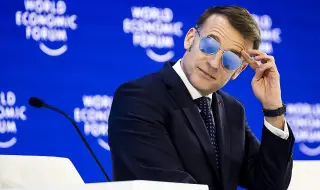
Macron's speech was perceived as a real counter-offensive against Trump's claims regarding Greenland and his behavior towards the EU in general, commented Agence France-Presse. This counter-offensive was reinforced by a coincidence. Due to a problem with a hemorrhage in one eye, Macron was forced to appear at the Davos forum wearing men's aviator sunglasses. In this look, reminiscent of Tom Cruise from the movie “Top Gun“, Macron raised his voice against “US diplomatic brutality”, notes Agence France-Presse.
Macron's speech and his appearance quickly became top news for media around the world and a hit on the Internet and social networks. On an account supporting the Democratic Party in the US alone, Macron's speech was viewed over 5 million times and was defined as “the most painful rebuke ever directed by anyone at Trump“. However, many emphasize that the success of this speech would not have been the same without the glasses worn by Macron. The president delivered an almost equally powerful speech to the French military in Istres a few days earlier, but without glasses and with a red, bloodshot, and half-closed eye. This did not earn him admiring comments, but mockery that he had been slapped by his wife, Brigitte Macron. Now his dark glasses have given rise to a radically different reading of Macron's speech in Davos and have aroused admiration for it, analysts emphasize.
And the company that manufactured the glasses worn by Macron - “Henri Julien“, which is French but was acquired in 2023 by the Italian group “iVision Tech“, thanked the French leader in a statement for advertising its product, which costs 659 euros, in this way, without wanting to. The model literally began to be spent like hot cakes, and the company's shares on the stock exchange increased. The company explained that the model of the glasses is called “Pacific S 01“ and that they are manufactured in the factory in Lon-le-Saunier in the Jura. The glasses have bluish mirror lenses and double gold-plated frames, the company also explained. The Italian head of the manufacturer Stefano Fulkir, said that he was honored that Macron had chosen this particular product, which is part of French history and which highlights how valuable the products are in France. Fulkir said that Macron bought the glasses a few years ago and insisted on paying for them, even though the company offered them to him as a gift. He emphasized that Macron wanted to buy glasses that were entirely French-made, recall “France Info“, “Euronews“, “Parimach“ and “Figaro“.
Because of Macron's speech with aviator sunglasses, an incident was almost forgotten. Trump revealed that Macron had sent him a private text message in which he told him that he did not understand what he was aiming for with his actions regarding Greenland, but also pointed out that the positions of France and the United States on Syria and Iran coincided. In this private message, Macron proposed organizing a G7 summit in Paris, to which representatives of Russia would also be invited. Revealing that he had received such a private message, Trump mocked Macron, whom he called: "One of my friends. A very nice guy who I like very much, but who will not stay in power for long because his term ends next year." And then he rejected an invitation to participate in a G7 summit in Paris after the Davos forum. Macron's entourage confirmed that there was a similar private text message addressed to Trump by him. Macron himself told journalists that no G7 summit was planned in Paris after the Davos forum, but that he had indicated in a text message to Trump that he was available to organize such a gathering in order to overcome the transatlantic crisis, recall France 24, BFM TV, France Presse and Le Monde. In the text message, Macron suggested that on the sidelines of this meeting in Paris, there should also be talks with representatives of Syria, Ukraine and Denmark. It was not clear exactly when Macron sent this text message to Trump. Macron's entourage pointed out that in both private and public statements, the French leader defends the same line, and this was evident from the text message revealed by Trump.
At the same time, it was also revealed that the French organizers of the G-7 summit in Evian had agreed to change its dates from June 14-16 to June 15-17 because of Trump's birthday, which is June 14.
Macron's opponents said that the private text message he sent to Trump and the change in the dates of the G-7 summit showed that he was still trying to please the American leader, despite publicly claiming the opposite. Macron's supporters rejected this thesis.
And French officials pointed out that Macron's speech had had an impact. And the day after that, in Davos, Trump assured that he would not use force in relation to Greenland and that there was a framework for an agreement on Greenland, without going into details. In addition, he abandoned the introduction of tariffs, with which he had threatened several European countries that dared to raise their voices against him in relation to the Arctic island. On the same day, however, Trump gave his speech to the delegates of the Davos forum, in which he emphasized how good the situation in the United States is now and praised his strict migration policy. He again mentioned Greenland, on which the security of the United States depends, although he confused it with Iceland several times. Trump also criticized "those fools" who buy components for wind energy and thus enrich China, and then told the Europeans that today they would speak German and a little Japanese if it were not for the American intervention in World War II. Trump also made fun of Macron's sunglasses in his speech, saying that he wore them to look tougher. But his mockery only increased interest in this accessory and, more broadly, in Macron's speech.
The day after, while Trump was establishing his Security Council, without formalizing the reservations and objections to it expressed by some countries around the world, including France, the 27 EU member states held an extraordinary summit on Greenland. At the meeting, the countries agreed that NATO should have a permanent presence in the Arctic and around Greenland. The meeting also discussed another issue - how to respond to Trump in the event of new threats and what to do about his unpredictable behavior. Macron emphasized that he wanted France and Europe to be respected and welcomed the return of a much more acceptable situation with the United States after the escalation over Greenland. The French leader said the emergency European Council was intended to show the unity of Europeans in support of Denmark, its territorial integrity and sovereignty, but also to show that when Europe is united, strong and quick to react, things return to order and calm down. However, he warned that everyone must remain vigilant and said that whenever France or Europe is not respected, Europeans will raise their voices and act clearly, BFM TV and Agence France-Presse recall.
At the same time, French Economy Minister Roland Lescure pointed out that it was Macron's firmness on the Greenland issue that played a role in Trump's change of heart, Agence France-Presse reported. French government spokeswoman Maud Brejon emphasized that Macron's reaction to the dispute with Trump over Greenland was the strongest in Europe and that his speech in Davos contributed to the return to normality. Brejon also emphasized that the French are lucky to have a president like Macron at a time when other countries have leaders like Trump and Putin. French Foreign Minister Barrot, in turn, pointed out that the United States must stop blackmailing with tariffs, something Macron had already stated.
The same day, another illustration of the American leader's unpredictability came. In an interview with “Fox News“ he questioned the bravery of NATO allies in the nearly twenty-year war in Afghanistan. In response to Trump's statement that the allies had stayed away from the front during this conflict, Macron once again expressed his gratitude to the families of the French soldiers who died during a mission in Afghanistan. And his entourage described Trump's words as "unacceptable statements that are not even subject to comment," recalls "TF 1". Outraged reactions and protests also came from Great Britain, Italy and Denmark, all of which also lost their soldiers in this conflict.
At the same time, Trump once again developed the thesis that he personally forced Macron to increase the price of American medicines sold in France after threatening him with American tariffs on French exports. He developed this thesis more than once last year and even imitated the conversation that supposedly took place between him and Macron and the requests in English with a French accent, addressed to him by Macron not to increase the tariffs. This time, however, an angry tweet from the Elysee Palace followed, clarifying that Macron does not set the prices of medicines in France, which have also remained stable. The presidency added that Trump's claims were fake news, Agence France-Presse reported.
These incidents illustrated that the tension in the relationship between Macron and Trump continues to simmer.
On January 28, Macron received in Paris (again wearing aviator sunglasses) the prime ministers of Denmark and Greenland. He told them that the tension between Europe and the United States over the Arctic island should become an occasion for a strategic awakening in Europe and that the Old Continent must act faster and stronger to rearm and achieve strategic autonomy, Agence France-Presse reported. Macron also emphasized that France supports an increased commitment by NATO in the Arctic and that it is ready to join such an initiative. Then he surprised his guests by speaking clearly and distinctly in Greenlandic, and then in Danish, to assure them that Denmark and Greenland were supported by France, that the Greenlanders were the ones who should make decisions about their future and their territory, and that Greenland was not for sale, nor could it be taken over, recall BFM TV and “Figaro“.
This resort to a foreign language aroused just as much interest in Macron as his Davos speech in English. Some Internet users mocked the way the French leader spoke Greenlandic and Danish and compared him to an IKEA customer listing an order list.
Meanwhile, Macron's Davos speech continued to "have a striking effect" on the Internet for another reason. In it, Macron twice admitted that Europe is sometimes too slow and needs reforms. To emphasize this, he also used the expression "for sure", which in English is "For sure". Macron pronounced it with a French pronunciation, so it turned out something like "fouche", and this gave rise to jokes on the Internet. But various French performers and musicians, as well as ordinary music fans, saw in this pronunciation a melodiousness and quickly transformed this paragraph from Macron's speech into a song, performed in different musical styles, recall "Euronews", "Le Monde", BFM TV and other French media. Artificial intelligence-generated clips in this direction also circulated on social networks. A video of Macron playing the piano in a piano bar and First Lady Brigitte singing the iconic excerpt from his Davos speech, transformed into a soulful jazz tune, was a hit.
On January 27, British Prime Minister Keir Starmer decided to imitate Macron and appeared in sunglasses during a talk show in a London theater, causing a sensation. He greeted the audience in French and then uploaded the video of this humorous scene to his TikTok account. In a comment shortly after, Macron wrote the now iconic "For sure," recall Agence France-Presse, Le Figaro and BFMTV.
On January 30, German Foreign Minister Johann Wadeful posted a short AI-generated video on his social media channels, in which the EU is advertised with excerpts from Macron's speech in Davos, recalls the “Huffington Post“. The video also features a penguin wearing a backpack on its back, which, by the way, also features Macron's face. In the clip, Macron, but also Starmer and Merz, praise the values of the EU, and the penguin starts to smile when it hears Macron's words in particular that "Europe is a good place". The penguin is the same one that appeared in an AI-generated image released by the White House a week ago, which showed Trump advancing in Greenland, holding a penguin by the hand. The video with the penguin and excerpts from Macron's speech, now published by Vaudeful, was quickly reposted by French ministers.
All this reflected on Macron's rating, which jumped by two percentage points, from 25 to 27 percent, according to the Toluna-Harris poll published on January 30, the Senuse website recalls.
But the first month of Macron's penultimate year in office was not limited to Greenland and squabbles with Trump.
France struck a blow against the Russian shadow fleet when it seized the oil tanker Grinch in the Mediterranean on January 22. The operation, which involved two helicopters, was carried out in full compliance with the rules of the UN Convention on the Law of the Sea, Macron assured. At the same time, Macron's idea, formulated last year, to resume dialogue with Russia, has begun to find followers in Europe. Italian Prime Minister Giorgia Meloni has also expressed her support, ANSA and Agence France-Presse recall.
Regarding Syria, Macron welcomed the agreement that envisages the integration of the Syrian Democratic Forces - an ally of France in the fight against Islamists - into the Syrian security apparatus of that country, Agence France-Presse reported.
Regarding Iran, France supported Italy in its call for the inclusion of the Islamic Revolutionary Guard Corps on the EU list of terrorist organizations, and this became a fact on January 29. Macron also strongly criticized, along with European partners, the violent suppression of protests in the Islamic Republic.
On Africa, Macron called for more French investment in the continent, and the French parliament began discussing a bill that would facilitate the return of foreign artifacts illegally acquired by France during the colonial era.
In January, the EU concluded a long-awaited trade agreement with India, which will allow France to export to the Asian giant. At the same time, Macron spoke out against the agreement between the EU and Mercosur, but France failed to gather a sufficient blocking minority in the EU and the treaty was initialed on January 17 by the leadership of the Euro bloc during a ceremony in Paraguay. This led to protests on French soil by French farmers, but representatives of some industries welcomed the agreement because it opened up new markets for them.
It was the Mercosur deal that also led to two no-confidence votes against the French government, submitted to the National Assembly by the far right and the radical left. Le Corneille's cabinet survived them. Then the prime minister broke his promise and passed the revenue and expenditure parts of the draft budget through parliament without a vote, which led to four more no-confidence votes, in which the government survived again. On Friday, Le Corneille pushed through the entire text of the draft budget using the same procedure, followed by the submission of two more votes of no confidence against it by the radical left and the far right, which will be voted on tomorrow, with the government expected to survive again, as they will again not be supported by the conservative right and the socialists.
Meanwhile, France, together with Italy, Malta, Hungary, Poland, Slovakia, Romania, Austria and Belgium, has been included in the EC's list of "bad students" in the Eurozone in connection with excessive budget deficits, and the corresponding penalty procedure has been initiated against it, notes Agence France-Presse.
Gabriela Golemanska, BTA