Comment by Georgi Lozanov:
A protracted absurdist play in three acts has ended, which can be called "The elected unelected director general of BNT". It is about a director, a regulator and a court, with secondary characters also passing through the stage. The role of the director was still "by author" assigned to Koshlukov, and the role of the court (in different formations) was to help the CEM choose exactly this director and to prevent him if he does not want to choose him. At least until the end of the third act, when the court also threw up its hands and let the regulator finally choose someone else.
But everything got off to a false start: in the 2017 competition, the SEM failed to choose Koshlukov because he did not have enough managerial experience, despite its attempts to somehow fabricate it. And he was appointed program director of BNT in order to "gain experience", and Konstantin Kamenarov became the general director, against whom - an important detail - criminal proceedings had long been ongoing. But the verdict was pronounced just when Koshlukov had accumulated the necessary experience, which left the suspicion, confirmed by the events that followed, that the court would be among the main characters of the play.
How Koshlukov Became Director of BNT
Its second act began with the appointment of Koshlukov as acting director general in place of the convicted Kamenarov. Nothing, but Koshlukov, while being the program director, finds it appropriate to show the middle finger on the air, which is why the CEM fined the public television for violating good morals. In its history, such a humiliating sanction is more than rare, and failure to comply with it was a sign that the upcoming competition for the general director was predetermined in favor of Koshlukov again. And so in 2019, he was elected by the CEM as the regular head of BNT, but his management provoked widespread resistance - the accusations were of political involvement, disregard for editorial independence, taking down programs and removing journalists. In the civil protests in 2020, which led to the fall of the government, along with the resignations of Borisov and Geshev, Koshlukov's was also demanded, and the petition to prevent him from participating in the next competition in 2022 reached 3,000 signatures. However, this does not at all deter him from running for a second term, but in the context of public discontent, the members of the CEM, with the exception of one, do not do so openly (even if they were persuaded to support him) and he does not collect enough votes. Moreover, Venelin Petkov, whose professional integrity is not in doubt, has entered the race, but who also does not collect enough votes so that no one can be elected and Koshlukov, as a "status quo", continues to govern.
This is already the third act of the play, when the court prevents the CEM from holding a new competition on the basis of various, well-coordinated complaints and Koshlukov remains an elected-unelected director general for longer than a full regular term. This administrative-legal absurdism, beloved of the deep power in the state, has only now been interrupted by the election of Milena Milotivova, against whom Koshlukov is again in a hurry to file a complaint.
He, despite the fact that he had actually exceeded the two mandates allowed by law and that he personally challenged the conduct of the competition itself in court, had his eyes set on appearing in it. Some members of the CEM even gave a not bad assessment of his management, probably due to upbringing, but also because they did not comment on journalistic content, but on digitalization, film production, salaries... A fragment of Koshlukov's own statement at the CEM hearing is indicative of Koshlukov's attitude towards journalistic content: "I know what independent journalism means. I have lied about being denied access to information and literature. And for me, this is not a principle or a declaration so that we can win European projects and a few leva from "America for Bulgaria". We never took any".
Let's leave aside the autopathetic, but to see the great threat to the independence of journalism, instead of its ties to power, in Euro-Atlantic funds and foundations, besides being in resonance with Putin and Peevski's battle with NGOs, is a self-admission that you have no place in a public media. Because the work of journalism in it, far more actively than in private media, is to exercise its critical function towards power - the overt and the covert, the actual and the potential. And this implies that the point of view of their representatives in news and journalistic formats is not simply not dominant, but that they are placed in a situation of mandatory media discomfort and are the subject of investigative journalism, which is currently almost absent. In general, there are serious substantive deficits of BNT under Koshlukov's management. Of course, there is no reason to put all journalists in the same boat, and in general, their undoubted professional qualities will receive a new stimulus when change begins on the 10th floor of "San Stefano".
Will Milotinova succeed in implementing change?
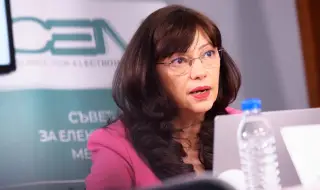
The question is whether Milena Milotinova will be able to implement it, for which she currently needs two mandatory qualities - professional authority and civic courage. Her authority is built on the basis of her own practice as a reporter, newsman and documentarian at BNT and then as the host of the foreign policy program with a focus on the EU "Brussels 1" on Bulgaria On Air. This experience gives weight to her claims that she will guarantee "compliance with European journalistic standards", will seek dialogue with her colleagues and together they will make "television in the interest of society". Beautiful words that can become reality only if Milotinova also shows civic courage. She needs it to resist the political pressure that her position inevitably causes and as a "buffer" to ensure freedom of speech on public television. In fact, this is precisely the main job of its director general.
And in order to be a buffer against political addictions, you must first of all not have any yourself. And here the professional biography is indicative. Milotinova's is not only journalistic, but also political – she was a deputy and chairman of the Media Commission after the "coming of the tsar". And then there is an episode of political interference, precisely with regard to BNT. A law was passed that effectively prematurely terminated the mandate of the incumbent director general – Lilyana Popova. Whatever claims there may have been to her activities, they cannot justify the neglect by "royal will" of one of the main democratic mechanisms - the mandate.
But this is a story with a quarter of a century of history - and about Milotinova's commitments to a political subject that has long been no longer part of the landscape. So we can hope that today she will be motivated entirely by her ethics as a journalist and will devote herself, as she declared in her presentation, to the formulation and implementation of the public mission of BNT. And this means that the public media should actively contribute to solving the two major problems facing society today, which are interconnected - corruption and the return to the post-Soviet zone of influence. Programmatic movement in this direction will be the best attestation for the election of CEM.
Good luck, Milena!