As US forces increase their presence in the Middle East, Iran faces the threat of large-scale strikes by the world's most powerful military, potentially targeting its leaders, military, nuclear facilities and critical infrastructure.
Iran is nowhere near having such capabilities and is even more vulnerable after the war launched by Israel last year and recent anti-government protests. But it can still inflict damage on American forces and allies, and may feel the need to do so if the survival of the Islamic Republic is at stake.
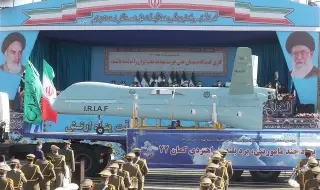
Despite Iran’s heavy losses last June, Israeli estimates suggest the Islamic Republic still has hundreds of missiles capable of striking Israeli territory. Iran has a much larger arsenal of shorter-range missiles capable of hitting American bases in the Gulf and American forces in the open seas, soon to be joined by a second aircraft carrier.
Iran has already threatened to close the Strait of Hormuz, a vital route for global oil trade, and said it had partially done so during military exercises last week.
Supreme Leader Ayatollah Ali Khamenei has warned that Iran could sink American warships, and senior officials have said a US attack would spark regional conflict. Iran's permanent representative to the United Nations, Amir Saeed Iravani, said that "all bases, facilities and assets of the enemy forces in the region" would be legitimate targets.
Iran still has the ability to strike
In June, Israel struck Iran's arsenal of longer-range missiles, as well as its military leadership and nuclear program, during a 12-day war. The United States struck Iran's main nuclear sites, which US President Donald Trump said at the time had been "wiped out."
However, the extent of the damage - and how much of it has been repaired - is still unknown. Iran continued to strike Israel with missiles and drones until the hostilities ended, at times even managing to outmaneuver its famed air defenses.
Iran’s arsenal of shorter-range missiles remained largely untouched, said Dani Sitrinovich, an Iran expert at Israel’s Institute for National Security Studies. That could make Iran more likely to retaliate against the tens of thousands of U.S. troops stationed in Qatar, Saudi Arabia, Jordan, the United Arab Emirates and elsewhere.
"Iran may be weak. But it still has ways to inflict real pain on the United States—and far more incentive to try than it had before," Nate Swanson, director of the Iran Strategy Project at the Washington-based Atlantic Council, wrote in the journal "Foreign Affairs". "Iranian officials believe they must defeat Trump or they will be permanently at risk," he stressed.
Iran fired missiles at a U.S. base in Iraq after the killing of its top general in 2020 and attacked a U.S. base in Qatar at the end of last year's war. Those strikes, which appeared to have been given advance notice, caused damage but no casualties because early warning and missile defense systems had been activated.
Iran has also held talks with China to buy anti-ship missiles that could significantly increase the Islamic Republic's ability to strike warships and block sea lanes, officials familiar with the talks told the AP.
The officials from both countries spoke on condition of anonymity because they were not authorized to comment publicly on the progress of the talks. They said Iran was in talks to buy YJ-12 supersonic anti-ship cruise missiles (exported as the CM-302), which fly low above the sea surface. The sources said the basic terms of the deal were finalized after last year's war, although no missiles have yet been delivered.
Who could succeed Ali Khamenei?
Last year's Israeli strikes killed several senior generals and nuclear scientists, exposing serious vulnerabilities. At one point, Trump said Washington knew where Khamenei was hiding, calling him an "easy target".
Shortly after the capture of Venezuelan President Nicolas Maduro, Trump may consider strikes aimed at overthrowing Iran's Shiite theocratic regime, which he recently said "would be the best thing that could happen."
The Iranians have had eight months to learn from their mistakes and strengthen their domestic security. Sitrinovic said Tehran likely has plans in place in case Khamenei is killed. Rather than appointing a successor, power would likely pass to a small committee until hostilities subside.
Experts say the death of the 86-year-old ayatollah, who has ruled Iran for more than three decades, would not in itself spell the end of the Islamic Republic. Power could eventually pass to someone close to him, as happened in Venezuela, or to someone within the ranks of the Islamic Revolutionary Guard Corps (IRGC).
US allies could become targets
US allies are visibly concerned about regional conflict, and Israeli Prime Minister Benjamin Netanyahu has warned that any Iranian attack on Israel would be met with a crushing response.
The Gulf Arab states have recently viewed Iran with alarm and rely on the US for protection, but they do not want to be drawn into war. Saudi Arabia and the United Arab Emirates, which host thousands of US troops, said they would not allow the use of their airspace.
A Gulf Arab diplomat said regional leaders were holding talks with Iran and the United States to avert war, warning that such a conflict could have serious consequences, including a spike in oil prices. The diplomat spoke on condition of anonymity to discuss the sensitive talks, which are being held behind closed doors.
Iran has allies including Yemen's Houthi rebels, armed groups in Iraq, Lebanon's Shiite militia Hezbollah and the Palestinian militant group Hamas. But the so-called "Axis of Resistance" has suffered heavy losses in the fighting that has erupted in the region since an unprecedented attack by Hamas militants against towns and kibbutzim in southern Israel in October 2023.
Iran or its proxies could also carry out attacks beyond the Middle East. Tehran has been accused of using criminal gangs and armed groups to plan and carry out attacks around the world, including against dissidents, Israelis and Jewish targets.
The nuclear issue
After initially threatening military action over the killing of protesters in Iran, Trump has shifted his focus to Tehran's nuclear program, warning that "bad things" would happen if Iran did not agree to a deal. The two sides will hold another round of talks in Geneva on Wednesday.
Iran has always insisted that its nuclear program is for peaceful purposes only, while the United States and other countries have long suspected that Tehran's ultimate goal is to develop weapons. After Trump withdrew from the 2015 nuclear deal, Iran has accelerated uranium enrichment, building up a stockpile of material enriched to levels close to those needed to create weapons.
Iran's largest underground nuclear facilities were hit in US and Israeli strikes, causing significant damage above ground. It is unclear whether the enriched uranium was removed before the strikes or buried underground. Iran says it has not been able to enrich uranium since then, but it has also banned inspections of its nuclear facilities.
Iran is still widely believed to be far from developing a usable nuclear weapon, but the radioactive material could pose a risk in the event of a large-scale strike.
Translated from English by Simeon Tomov, BTA