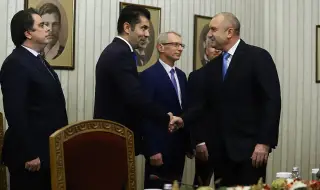
It is too early to put the post-election frying pan on the fire, but the most likely possibility after the elections on April 19 is a coalition between "Progressive Bulgaria" and PP-DB. It seems possible for several reasons. But there is one big obstacle.
From Daniel Smilov:
After the statements by Rumen Radev and PP-DB that they will not seek a coalition with GERB and DPS, the most likely possibility remains a coalition between "Progressive Bulgaria" (PB) and PP-DB after the elections on April 19. Of course, it is too early to put the post-election frying pan on the fire, because a lot depends on the results of the parties. Theoretically, it is still possible for Radev to try minority rule with support from "Vazrazhdane" or the Bulgarian Socialist Party (if it enters parliament). Theoretically, it is also possible for some party to have an absolute majority. But at least according to the campaign so far and the sociological surveys, such options are less likely.
Why a coalition between Radev and PP-DB is possible
A coalition between Radev and PP-DB is not only more likely, but also seems possible for several reasons. In the anti-corruption sphere, agreement on common actions can be obtained relatively easily. Andrey Gyurov's caretaker government actually demonstrates what can be done on an anti-corruption line even without a majority of 160 people in parliament and without legislative changes. First, the election shenanigans with vote buying and vote falsification can be greatly limited. So far, over 800,000 euros have been revealed, which were most likely prepared for vote buying. It is no coincidence that Minister Emil Dechev and Acting Secretary General of the Ministry of Internal Affairs Georgi Kandev have gained so much sincere sympathy from citizens, despite the base (politely speaking) attempts to discredit them in parliament by the ITN, DPS and other status quo parties. In a similar way, the Minister of Justice Yankulov threw a stone into the magistrate's drum: after his statements and actions, all of Bulgaria is now convinced that it is not normal for the country to have an illegal acting prosecutor general, nor is it normal for the chairman of the SGP to be so close to Petyo Euroto that she regularly shared both the establishment and his vehicles. The terrain is prepared for serious change, and it can and must happen after the elections.
From this point of view, the "Gyurov" cabinet demonstrates what a government and a parliamentary majority that actually aims to change the "Borisov-Peevski" model could look like. And that is why the government is targeted by representatives of precisely this model.
The obstacle
What constitutes an obstacle to a post-election coalition government between PB and PP-DB is not negligible, however. What is less significant, but still important, is the purely personal distrust between Radev and PP-DB. They have their past and disappointments with each other, especially when it comes to PP (while with DB, distrust of Radev and relations with him were rather constant). Personal incompatibility is not only at the level of leaders, but also at the level of voters. To the extent that some of Radev's voters are pro-Russian, a coalition between the PB and the PP-DB would lead to complaints and resentment in both camps.
This in itself is a significant, but not insoluble problem. Ultimately, in politics, people do not have to love each other to act together if they want to achieve something important and substantial. Leaders should not be as vindictive as elephants, and voters should give their leaders credit for trust when strategic decisions are made in the public interest. It is easy to say, hard to do. But it is not impossible.
The real obstacle to a coalition between the PB and the PP-DB lies elsewhere and it is no secret - the issue of the country's geopolitical direction. There are deep substantive differences here, although both formations generally look to the West and value (by request) Bulgaria's membership in the EU and NATO. But the problem is that a coincidence at such an abstract level is not enough, because it may turn out that they have different definitions of both what it means to "look to" and what the EU and NATO are. Although Radev is fluent on these issues, in the election race and especially with regard to the "Gyurov" agreement with Ukraine signed by the government, real and serious discrepancies are emerging:
1. The most important thing is clearly energy policy. Radev seems to be on the side of the circles in Bulgaria that want us to return to using Russian oil and gas with the argument that it is the cheapest. In fact, the rapid signing of a long-term contract with "Botaş" - the Turkish gas company, which has become a hub for Russian gas in Europe, could be read this way. Most recently, Radev stated in a pre-election context that we should have access to the cheapest oil and gas. However, Hungary's experience shows that Russian oil and gas are not that advantageous even in terms of price. But more importantly, a return to these energy sources would mean the lifting of EU sanctions against Russia, regardless of the course of the war in Ukraine. With its position on energy sources, Hungary has become Russia's "Trojan horse" in the EU, which has destroyed the trust of its partners in this country and it has remained isolated. In this sense, a basic question to Radev and his party is whether they are inclined to such a "trade": Russian energy in exchange for isolation in the EU. If they are not, then there would be no particular problem for forming a coalition with the PP-DB on this issue. However, if their answer is "we'll see", the divergence would be too dramatic;
2. In second place is the position regarding aid to Ukraine from the EU and Bulgaria in particular. Here Radev holds different positions from both the current political line of the country and the EU. It is clear that if the EU and NATO stop their military and financial aid to Ukraine, this country will quickly find itself in a critical situation on the front. If Radev's position is like that of Kornelia Ninova ("not a single cartridge for the front", while military production is massively exported to Ukraine), it will not be a problem for forming a coalition. But if Radev really wants to stop the aid and positions himself like Viktor Orban at EU and NATO meetings, blocking sanctions against Russia and other measures, then a coalition between him and the PP-DB would be rather impossible.
Rumen Radev's flexibility on these issues within the campaign does not make a post-election coalition more possible, because this flexibility can be interpreted in radically different ways.
This choice will be indicative of the line of "Progressive Bulgaria"
It is interesting that with so many appearances by the PB in the media, journalists have not yet asked them which of the European party families the PB will belong to. This choice will be of great importance and will be indicative of the party's line. For example, if Radev says he will join the European Conservatives and Reformists, he will be among leading parties there that are strongly pro-Ukrainian, such as Meloni's party and Kaczynski's. If he goes to join Le Pen or the "Alternative for Germany", the anti-European positions of these parties are obvious. If he chooses the European Socialists and Democrats, he would have to take into account the mainstream in the EU, etc.
The positioning of the PB in a European context is very important in view of the kind of Europe this formation wants. The PP-DB are for a highly integrated Europe that has a common defense and that harmonizes its financial markets and investments in leading technology companies. If President Trump continues to distance the US from NATO in order to preserve its sovereignty, European countries will have to invest a lot of money in defense and high technology. All of this can only be done together in order to be effective and on the scale of competitors from the US and China. The leading European economies have the primary responsibility to develop the model of this new Europe, and Bulgaria's task is to participate constructively in this process, which is of key national interest. This is a reasonable position and it is good that it was articulated clearly enough by the PP-DB during the pre-election period.
The PB should also form specific views on these issues. So far, Radev has often criticized the EU (where justified, where not), only sending messages about "making our voice heard" in Europe. We are generally vocal, but what is more important is what we want our voice to be heard about. If it turns out that "making your voice heard" means being like Viktor Orbán, who is hindering EU political integration, aid for Ukraine, and common defense, then a place for a coalition between the PB and the PP-DB will be difficult to find. If both parties are seriously concerned about a stronger and more integrated Europe, it is normal for them to have tactical differences on how it could be achieved in an already difficult international situation. But if the value horizon is common and European, reasonable compromises and solutions can be sought. If there is no community of values, Radev should rely on parties like the Bulgarian Socialist Party and even "Vazrazhdane", which in that case would be closer.
Perhaps it is strange that in the middle of the campaign such important - perhaps the most important - questions about the future of the country are still hanging. Those who are preparing to govern after the elections should already get into specifics on the essential topics.
This text expresses the opinion of the author and may not coincide with the positions of the Bulgarian editorial office and the State Gazette as a whole.