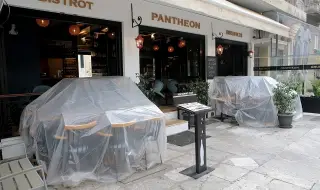
Since 2015, the growth of prices in establishments has been approaching 110%, announced economist Adrian Nikolov. Neither the price of energy, nor labor, nor other costs can explain the increase, he says. Richard Alibegov claims otherwise.
Against the backdrop of rising prices and the lack of a new budget, restaurateurs are once again demanding a 9% VAT - a relief that the sector enjoyed from July 2020 to the end of 2024. The request, announced by the chairman of the Bulgarian Association of Restaurants (BAZ), Richard Alibegov, angered many and caused an avalanche of comments on social networks due to the significant increase in prices in restaurants.
Bulgaria relies on VAT revenues
The only goods and services with a reduced VAT rate of 9 percent are hotel accommodation, paper and electronic books, including textbooks, as well as baby food, diapers and other such items. VAT revenues form almost half of all tax revenues in Bulgaria, which is among the highest levels in the EU - the average for the Community is about 20% for 2024. And for OECD countries, which Bulgaria has been striving for for over 12 years, VAT provides nearly a fifth of tax revenues.
Due to the huge contribution of VAT to the state budget, any request for its reduction is met with a knife by the authorities - regardless of who they are. However, some industries managed to win a lower rate during the COVID pandemic and kept the relief years after its end. For example, restaurants, gyms, catering, etc. used 9% VAT as a temporary anti-crisis measure, but it was later repealed.
"There are no arguments for the double price increase!"
People's dissatisfaction can be summarized with the words: "Prices in pubs are like in Western Europe, but salaries are not!" and "We have reached Western Europe in terms of the cost of restaurants!", and to these are added complaints about reduced portions and poor service.
Economist from the Institute for Market Economics Adrian Nikolov caused controversy, commenting that "with 43% overall inflation since 2015, the growth of prices in restaurants and cafes is approaching 110% for the same period".
He explained to Deutsche Welle that he finds no grounds for such an increase. "In practice, there was almost zero inflation until 2020. There were even years of decline. So almost all the inflationary pressure we are talking about was generated in the period 2020-2025." According to him, neither the price of energy, nor of labor or other costs can explain the outpacing price growth.
"Possibly maybe rents, but this is more likely in large cities. But we are not looking at the dynamics only in Sofia, Varna and Plovdiv, but the entire economy, because there is no regional breakdown. It is possible that where the markets are hottest, that is, large cities and tourist centers, the dynamics are higher", says Nikolov. He admits that there may be pressure on prices from a factor such as labor - due to the strong "lightening" of the sector in 2021. At that time, state aid for the COVID-pandemic was tied to the use of cash registers and declaring employment.
When asked about the share of the shadow economy, the economist replied that there are not very good indicators, since "at the sector level, the analyses are controversial". According to various estimates, it is between 20% and 30%, which is a fairly wide range, the most reliable are the studies that put it around 21-22% in recent years, and it is higher in labor, says Adrian Nikolov. When there is rapid growth, there is also a lightening. But when the labor market tightens - for example, with a sharp increase in the minimum wage, the opposite effect is seen, that is, more hiding.
"Whether the restaurateurs' demands will be accepted depends on the political situation. But it seems difficult to defend such a measure," Nikolov believes. According to him, in 2020 it was logical - with the closure of businesses, the collapse of tourism and direct restrictions. "Back then, state support, including through VAT, was largely logical. Now, despite the attempts of some businesses to try to put the current crisis in the shoes of the Russian war in Ukraine, or the COVID-pandemic, it is a crisis of a different manifestation and size."
An additional factor is the fiscal situation. At the beginning of the 2020s, Bulgaria entered with a relatively balanced budget and the possibility of state support. "Now we have a growing state debt and deficit on the verge of the Maastricht criteria (3% of GDP, b.a.). This greatly limits the possibilities for new relief. Any such measure means either reducing other expenses or increasing other taxes - both are politically difficult decisions,", the economist motivates.
"An empty plate starts at 4.50 euros!"
Richard Alibegov told Deutsche Welle that the situation is very different from the IME's calculations. "From 2018 to today, we have had a double increase in wages, more than twice the rent, 3 to 4 times the raw materials, energy costs. And since the crisis in the Middle East, suppliers have been constantly changing prices", he says.
The association he leads unites 900 companies with over 5,000 establishments, Alibegov says. He explains the pricing, emphasizing that the request for a lower VAT rate only affects food. "I can tell you how much an empty plate costs for a small, medium and large establishment - it starts at 4.50 and goes up to 10 euros. From there: 2-2.20 euros for a salad, 4 euros for taxes, and that's how much the salad costs... And from these 4 euros I have to set aside for repairs, to get my investment back, etc.," he says, combining different types of taxes into one amount.
The so-called "empty plate" includes the fixed costs of the establishment - rent, energy, administrative costs and part of the salaries, which are distributed over each portion. Higher values of 10 euros reflect establishments in central locations or the premium segment.
The businessman recalls that in many European countries there are differentiated VAT rates for food in establishments, except for basic foods and other goods. It is not right in Bulgaria for a restaurant in a hotel to have 9% VAT, and outside - 20%, he says.
When asked about the shadow economy, Alibegov replies that there must be one, but it is the institutions' job to deal with it.
Asked what the organization will do if their demands are not accepted, Alibegov says that everyone will decide for themselves, but some establishments will close. "Along the entire cost chain, I can only save on staff, which will be the customer who will suffer. The quality of service will drop, the work for the others will increase."
He gives an example with his business. "The menu in my establishments was printed and released at the end of September - for the fall-winter season. The calculation was made based on the prices then and it works like that to this day, with the new menu for spring-summer I will be at a loss." According to Alibegov, however, the more important thing is that rising prices worsen people's financial situation and they do not seek entertainment, and when they do, they limit their consumption. "The result is that turnover falls and expenses rise. Our only source of income is the customer, and when he saves, the business is under pressure."
The debate on VAT for establishments remains open - between arguments for the survival of the business and the question of how much restaurant prices reflect real costs. And a wave of demands is already rising for the future regular budget.