Author: Emilia Milcheva
For more than 15 years, the park “Kleptuza” has been in ruins, and a concrete structure now protrudes from the old spring catchment, which has led dozens of people to protest. According to them, the repair and reconstruction project, implemented by the Velingrad municipality, has disturbed the natural appearance of the spring. However, the local authorities claim that this is the only way to use part of the water for water supply and for business.
"It was very nice at Kleptuza once upon a time, we children drank lemonade and played, the adults ate kebabs, music was playing. My wedding was there. Now I don't feel like stepping on it, seeing how ruined it is and the lakes have turned green. And now this concrete…", recalls a resident of Chepino - the Velingrad district where Kleptuza is located.
The concrete that sparked protests
"This concrete" is a U-shaped shaft, placed at the place where the spring waters emerge from the cave, follow a small waterfall and flow into the lakes. There will also be a sanitary-security zone around it, 10 X 10 meters, surrounded by a fence. Decades ago, barrels of wine or crates of beer were placed in this place - to cool down. The water temperature is constant - 8 degrees Celsius, and the flow rate of the spring reaches 1000 l/second, writes the unofficial “Rabotnichesko delo” in 1962. It is even reported that a Balkan trout with a spindle-shaped body often appears in the waters.
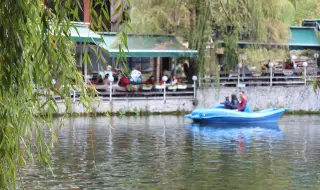
Now only a few ducks swim in the lakes of Kleptuza, released two years ago. The buildings around, including the restaurant, are wrapped in wooden paneling because they are dangerous. Over the years, many promises have been made to restore the appearance of the place, whose decline stands out even more against the background of the unique nature. The mayor of Velingrad, Kostadin Koev, elected with the support of GERB, is at the head of the municipality for a third term. Velingrad residents have not forgotten how in the fall of 2023 he promised: “You rip, don't rip, Kleptuza will be built!” However, there are 17 months until the local elections next year, and the place is far from being transformed. For the people of Velingrad, Kleptuza is not just a park or a water source, but part of the city's memory and identity.
Spring water (from) Velingrad
The conceptual projects for the transformation of the park are not going well - one was rejected, another appealed, but those for using water from the largest karst spring in Bulgaria are moving faster. In January 2023, the owner of the water - the Basin Directorate of the “Eastern Aegean Region”, allowed "Timbark Bulgaria", the company that bottles mineral water with the “Velingrad” brand, to use a flow rate of up to 7 l/second from Kleptuza. The reason is that the company, which has a concession for mineral water from Velingrad, is also developing a brand for spring water. Another 80 l/second of the spring water is planned for the population's water supply.
"Timbark Bulgaria" is part of the huge Polish concern Maspex Group - a multinational company with billion-dollar turnover, which, in addition to juices and mineral water, also owns some of the most famous alcohol brands in Eastern Europe, including Żubrówka, Soplica and Bols.
When asked by Deutsche Welle, “Timbark Bulgaria” explained that there is no risk to the water supply, since “the water diversion is designed so that it can only take water after the needs of the city of Velingrad and the village of Draginovo have been met”.
The company points out that the project does not aim at additional water intake from the karst spring itself, but at capturing water that “is currently being lost” through cracks in the rock massif. According to the company, the repair activities are aimed at diverting this water to the city water supply system, and not at changing the natural regime of the spring. The company states that the flow rate for the water supply to the city network can be “improved and even doubled“.
But the problem is that even if there is more water, a large part will be lost through the outdated network. Velingrad has missed the opportunity to receive funding for the so-called “water cycle” and to modernize its water supply network. In response to questions from Deutsche Welle, the Ministry of Environment and Water responded that the “Eastern Aegean Region” Basin Directorate issued two opinions in 2023 and 2024 on the admissibility of investment proposals by “Timbark Bulgaria” Ltd. - for water intake and for the route of a new water supply system, supplied by the water intake facility KEI “Kleptuza“ (captured natural spring).
The Directorate sets conditions, including “selection of technical solutions that will not cause damage or negative consequences for water sources, as well as to coordinate the planned activities with “VKTV“ Ltd. - city of Velingrad” (the water supply operator, b.a.), so as not to harm the city's water supply.
“Timbark Bulgaria” will receive water through a 900-meter diversion from the municipal water supply system, and not directly from the source itself. From the response of the Ministry of Environment and Water and the municipality, it is clear that in addition to the diversion, a reservoir, pumping facilities and measuring devices are also planned. According to the institutions, this will not affect the natural self-flow of Kleptuza, since the water will not be pumped directly from the source, but from reservoirs supplied by a diversion from the existing water supply system for Velingrad and Draginovo.
In February 2023, the investment proposal of “Timbark Bulgaria” was approved by the director of the Regional Inspectorate for Environment and Water-Pazardzhik Kostadin Geshev. At that time, the office of Galab Donev, appointed by President Radev, was in charge. All of them are in the executive branch today, including Geshev as Deputy Minister of Environment and Water. The Minister of Environment is Rositsa Karamfilova, who held the position in several government offices, including under Donev.
Before the Regional Inspectorate for Environment and Water gave the green light to the investment proposals, Karamfilova issued an order to reduce the area of the protected area "Kleptuza" by 71.585 decares, and the two lakes and the karst spring were not included in it. At the end of last year, the Administrative Court-Pazardzhik overturned the order of the Minister of Environment, appealed by the fishing association NILET, as illegal. And the Ministry of Environment and Water filed a cassation appeal.
In its response to the State Gazette, the Ministry of Environment is categorical that "the two artificial lakes and the karst spring are not and have never been part of the protected area (PA) "Kleptuza". These sites fall within an urbanized area - the city park “Kleptuza“, while the protected area “Kleptuza“ includes forest areas located above the spring and lakes”. Velingrad Municipality confirms this - with the General Development Plan of 2014.
The new infrastructure is being built without an EIA (environmental impact assessment). The Regional Inspectorate for Water and Environment-Pazardzhik considers it unnecessary, since the project does not fall among the activities for which the law requires such a procedure. The arguments are that it uses the existing water supply system and no significant increase in water use is planned.
Protesters: The destruction is great
However, the construction activities around Kleptuza raise questions about the quality of the project and the control over its implementation. The contractor is the company “Delchev Engineering”. It is the only candidate for the project for 4.347 million leva with VAT (2.22 million euros), which also wins many other orders in the area.
According to protesters, when the installation of the new concrete facility (water intake shaft with overflow) began, an intervention was made in the base of the channel that drains karst waters from the outlet points through the waterfall to Lake Kleptuza. They believe that as a result of the construction activities, part of the channel wall was compromised and the water began to flow towards the foundations of the neighboring building - the so-called old casino.
This necessitated the construction of a temporary channel and the installation of a pipe at a lower elevation to drain part of the water to the Chepinska River. It is during these emergency actions that doubts arise about the impact on structural elements related to the stability of the building. One of the main criticisms from Velingrad residents is that the project was not publicly discussed, even though it affects the emblem of Velingrad. The municipality points out that the law does not require such a procedure.
The first protest, organized by the civic initiative “For Kleptuza“ with over 500 participants, demanded the removal of the concrete structure and the restoration of the spring's previous appearance. The chairman of NILET Anton Boyadzhiev also insists on a new vision for the shaft and a public discussion, according to whom the construction work should be stopped.
"We have nothing against development and investments. The question is whether such an intervention in the most emblematic karst spring of Velingrad can happen without a real public debate and with so many uncertainties surrounding the implementation," says Ivan Petrov, founder of the civic initiative "For Kleptuza".
More than a week ago, the regional governor of Pazardzhik Borislav Bogoslovov ordered an inspection after receiving a signal from protesting citizens of Velingrad and meeting with deputies and representatives of the Basin Directorate, the Regional Directorate of Water Resources, the Regional Inspectorate for Environmental Protection and the project contractor. When asked by Deutsche Welle about the results of the inspection, the regional government replied that they were still collecting the reports from the institutions.
The MP from “Progressive Bulgaria” Vaska Milusheva, who is from Velingrad, is also awaiting the results of the inspections. In a post on social networks, she stated that she had found “the lack of timely and quality control over the repair activities, which led to damage to part of the spring and the galleries of the lake”. The MP from “We continue the change” Ivaylo Shotev, on the other hand, requested a hearing in parliament of two ministers - of the MRDPW and the MEW, due to the construction activities of the spring, but it was rejected by the votes of “Progressive Bulgaria”, GERB and DPS.
The Municipality: We are fighting against water scarcity
The fight against water scarcity is the main argument of Mayor Koev and his team, who believe that a way can be found to somehow integrate the vision of the concrete facility with the environment. However, he is categorical that there was no other way - to secure the shaft and prevent pollution. “Kleptuza is the closest resource in the vicinity, we have water for a river and more, and we want to solve future water crises with a new water supply system for the city”, Koev also said at the round table organized in the municipality last week.
To the problems with the old and failing water supply network, local residents also add the increased consumption in the resort town, especially due to the development of SPA tourism and large hotels. Against this background, any intervention around Kleptuza causes particular sensitivity.
People are aware of the problem of water scarcity, but they insist on returning to Kleptuza's previous appearance. At the round table in the municipality, the chairman of the Union of Hoteliers and Restaurateurs Zlatko Zlatanov suggested thinking about some beautiful vision of the concrete shaft, for example with glass and lights. However, the Velingrad municipality explained that any change to the project means new permits - that is, new three years.
What does Velingrad offer tourists
In fact, the dispute over Kleptuza is also a dispute about what kind of tourist city Velingrad wants to be. For decades, the resort has mainly sold beds, SPA treatments and mineral water, but outside of the hotels, tourists are rarely offered a real experience related to the history, nature and memory of the place.
The “SPA capital of the Balkans” has long lived on its water, but it has difficulty telling its story. In many European resorts, legends, cultural life, a sense of uniqueness are built around springs like Kleptuza. Instead, today the most famous karst spring in Bulgaria is at the center of a dispute over concrete, pipes and institutional solutions.